

Goobuy’s 4.3mm F0.8 M18×0.35 lens is an ultra-large-aperture wide-angle optical solution for 1/1.8-inch low-light camera platforms, designed for 4K and high-sensitivity CMOS sensors such as Sony IMX678, IMX334, onsemi AR0822, OMNIVISION OS08A20 and Sony IMX347, with additional evaluation for 1/2-inch large-pixel sensors including IMX385. It supports up to 8MP / 4K optical resolution, approximately 110° horizontal FOV on 1/1.8-inch sensors, and is intended for low-light industrial imaging, STARVIS / STARVIS 2 cameras, NIR night vision, robot auxiliary vision, teleoperation and dark equipment observation where a conventional M12 lens may not provide enough optical aperture.
date: September 29, 2026, shenzhen, china. source: shenzhen novel electronics limited
Goobuy is expanding its low-light imaging platform with a new F0.8 ultra-large-aperture M18 lens designed for large-format CMOS camera systems that require more light collection, wide-area coverage and 4K-class optical resolution.
This 4.3mm lens uses an M18×0.35 mount, supports an image circle up to approximately Φ9.3mm, and is designed around 1/1.8-inch class image sensors. With an F0.8 fixed aperture and approximately 110° horizontal field of view on 1/1.8-inch sensors, it is being evaluated for high-sensitivity USB, PoE, AHD and embedded camera platforms used in dark machinery areas, protected industrial equipment, night observation and other low-light imaging applications.
Current sensor candidates under evaluation include Sony IMX678, Sony IMX334, onsemi AR0822, OMNIVISION OS08A20, Sony IMX347 and Sony IMX385.
The goal is not simply to offer another interchangeable lens. Goobuy is evaluating complete combinations of sensor + lens + M18 holder + camera board + interface so customers can start from an existing low-light camera platform instead of developing an optical system from zero.
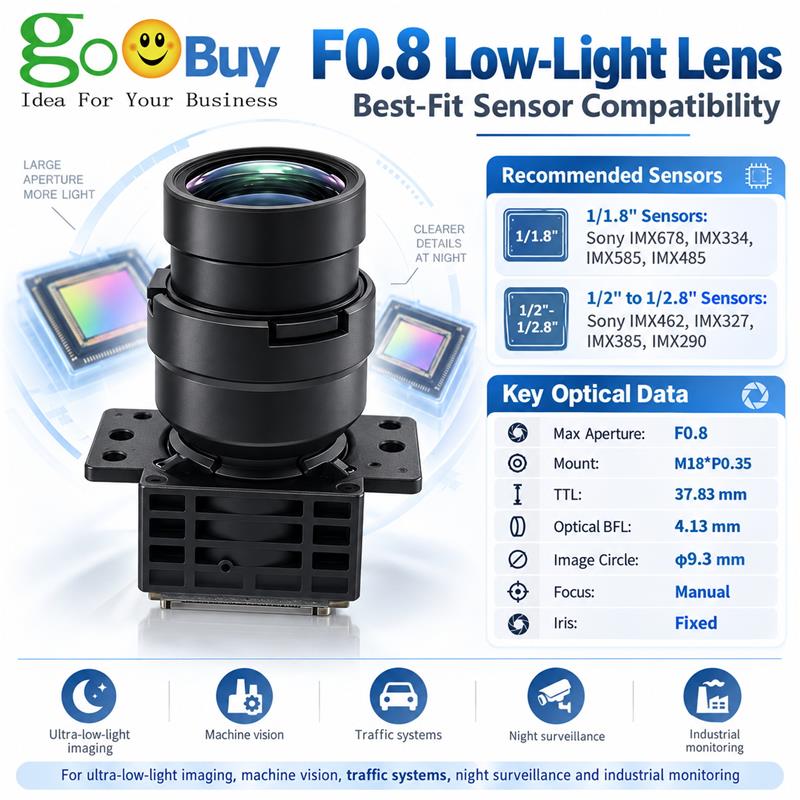
| Parameter | Specification |
|---|---|
| Focal Length | 4.30mm ±5% |
| Maximum Aperture | F0.8 |
| Mount | M18 × P0.35 |
| Image Circle | Φ9.3mm max |
| Optical Resolution | 3840 × 2160 / 8MP |
| Optical BFL | 4.13 ±0.2mm |
| Mechanical BFL | 3.9 ±0.2mm |
| TTL | 37.83 ±0.2mm |
| Minimum Object Distance | 1.5m |
| Focus | Manual |
| Iris | Fixed |
| CRA | 8° |
| 1/1.8" HFOV | Approx. 110°–112° |
| 1/1.8" VFOV | Approx. 59°–60° |
| 1/1.8" DFOV | Approx. 131°–134° |
| Optical Distortion | Approx. -53% to -56% |
| Relative Illumination | Approx. 39%–41% |
The large F0.8 aperture is the main reason for evaluating this lens for ultra-low-light camera modules, but aperture alone does not determine final night performance. Sensor sensitivity, pixel size, exposure time, ISP tuning, noise reduction, lens transmission, IR-cut filter, scene motion and illumination all affect the final image.
For this reason, Goobuy recommends evaluating the complete camera system rather than selecting a lens only from the nominal F-number.
Compared with conventional small-aperture lenses, an F0.8 camera lens can deliver substantially more light to the image sensor under the same scene conditions.
This can be valuable in applications such as:
The practical benefit is not simply a brighter image. A large-aperture optical system may allow the camera to operate with lower electronic gain or shorter exposure time, helping reduce visible noise or motion blur depending on the sensor and ISP configuration.
Actual improvement must be verified with the final sensor, camera board and lighting condition.
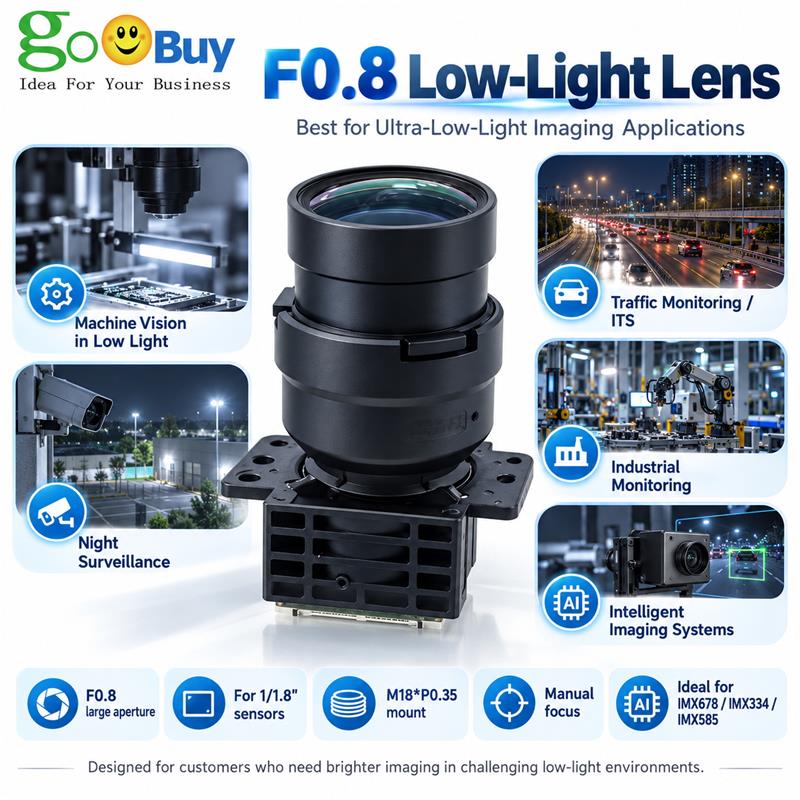
The Sony IMX678 is one of the most important sensors Goobuy plans to evaluate with this F0.8 M18 lens.
IMX678 uses a Type 1/1.8 optical format, approximately 8.86mm diagonal, 2.0µm pixels and 3840 × 2160 recommended recording resolution. Sony positions the sensor within its security-camera image-sensor family.
This makes the combination especially interesting for:
IMX678 F0.8 camera
IMX678 low-light camera module
IMX678 M18 lens
4K STARVIS 2 camera
1/1.8-inch 4K low-light camera
A possible Goobuy platform direction is:
IMX678 + F0.8 M18 + 4K USB / PoE camera
for customers who want wide-angle 4K imaging with improved low-light capability.
Because the lens image circle is only moderately larger than the IMX678 sensor diagonal, production validation should include corner illumination, edge MTF, focus uniformity and mechanical alignment.
The Sony IMX334 is another natural candidate for this lens because it belongs to the established 1/1.8-inch 4K camera ecosystem.
For customers already using IMX334 camera boards, replacing a conventional lens system with an F0.8 M18 optical configuration may be a practical way to evaluate a lower-light 4K camera without changing the complete imaging platform.
Relevant search and engineering terms include:
IMX334 low-light camera
IMX334 M18 lens
IMX334 4K camera module
F0.8 lens for IMX334
1/1.8-inch low-light camera lens
Goobuy treats IMX334 as an evaluation candidate rather than claiming universal compatibility. Holder geometry, sensor cover glass, optical alignment and corner performance must be checked on the actual camera board.
The onsemi AR0822 is particularly interesting for customers who need a combination of low light, high dynamic range and near-infrared performance.
AR0822 is an 8MP stacked 1/1.8-inch BSI CMOS sensor with a 3840 × 2160 active array, 2.0µm pixels and support for 4K video up to 60fps. onsemi specifies up to 120dB embedded HDR and enhanced NIR response, and lists robotics among its applications.
This creates a strong potential combination for:
AR0822 low-light camera
AR0822 M18 lens
4K HDR camera module
NIR industrial camera
robotics vision camera
120dB HDR camera
AR0822's published typical CRA is approximately 10°, relatively close to the lens specification of 8°, but final optical compatibility still requires real module testing.
For customers working in scenes containing both bright highlights and dark equipment areas, an AR0822 + F0.8 lens combination could be more relevant than simply increasing resolution.
The OMNIVISION OS08A20 is another important 1/1.8-inch 8MP candidate.
It uses 2.0µm pixels, supports 3840 × 2160 video at up to 60fps and includes enhanced quantum efficiency around 850nm and 940nm, making it especially relevant for near-infrared imaging.
Potential applications include:
This makes OS08A20 + F0.8 M18 lens a potentially useful configuration for customers who use IR illumination rather than visible-light-only imaging.
The published lens CRA for OS08A20 is approximately 11°, so corner response should be validated with the actual holder and module configuration.
Not every low-light application requires 4K resolution.
The Sony IMX347 is a Type 1/1.8 sensor with approximately 4.09MP recommended recording resolution and 2.9µm pixels.
This creates a different design direction:
larger pixel + F0.8 aperture + moderate resolution
rather than:
maximum resolution + small pixel
For customers prioritizing sensitivity, dynamic scene visibility or lower-light operation over 4K detail, an IMX347-based camera may deserve evaluation.
Possible search terms include:
IMX347 low-light camera
IMX347 industrial camera
1/1.8-inch 4MP low-light camera
large-pixel night vision camera
Goobuy is also interested in evaluating selected 1/2-inch class large-pixel sensors with this lens.
The Sony IMX385 is especially relevant because it has historically been used in low-light imaging applications and represents a different product strategy from IMX678 or IMX334.
Instead of positioning it as a 4K camera, the commercial logic would be:
1080P + large pixels + F0.8 + low-light optimization
Possible target searches include:
IMX385 low-light camera
IMX385 F0.8 lens
1080P ultra-low-light camera
large-pixel night vision camera
industrial dark-area camera
Because a 1/2-inch sensor uses less of the lens image circle than a 1/1.8-inch sensor, field of view will be narrower, but optical coverage is easier.
For some customers, this may be more valuable than using an 8MP sensor.
Most compact board cameras use an M12×0.5 lens mount.
This lens uses a larger:
M18×0.35 mount.
The larger mechanical and optical structure is useful for supporting:
For this reason, Goobuy does not recommend treating the lens as a simple replacement for a standard M12 lens.
A more suitable architecture is:
CMOS Sensor PCB → Dedicated M18 Lens Holder → F0.8 M18 Lens
The M18 holder must be selected or designed around:
For customers searching for an M18 lens holder for IMX678, M18 camera lens mount, M18×0.35 board camera holder or M18 lens for 1/1.8-inch sensor, Goobuy can evaluate the mechanical combination together with the camera platform.
A technically compatible sensor size does not automatically mean a production-ready camera.
For an F0.8 large-aperture system, Goobuy recommends checking:
CRA compatibility
image-circle coverage
corner illumination
edge MTF
sensor-to-lens alignment
lens tilt
sensor tilt
cover-glass thickness
IR-cut filter thickness
focus consistency
distortion correction
mechanical back focal length
These factors become especially important with large 1/1.8-inch sensors because the lens is operating close to its full image circle.
A camera may look sharp in the center but still show corner softness, asymmetric focus or illumination falloff if the mechanical holder is not sufficiently accurate.
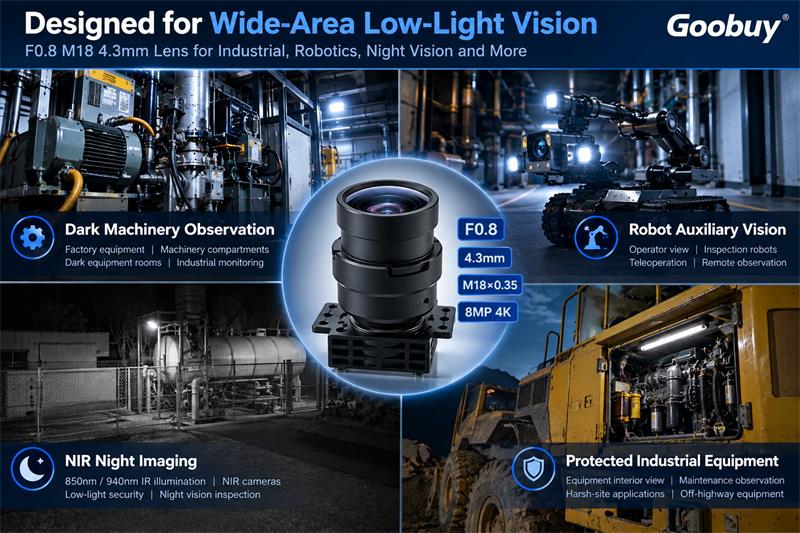
Goobuy sees the strongest potential in applications where both wide field of view and difficult lighting conditions matter.
Suitable for observing machinery, factory equipment, enclosed industrial areas and protected equipment interiors where conventional lenses require excessive gain.
Potential combinations with Sony IMX678, IMX334 and other large-format low-light sensors can support high-resolution night or dark-area imaging.
The lens can provide a wide operator view for robot bodies, maintenance robots, inspection robots and teleoperation systems.
It should not automatically be treated as a calibrated SLAM, stereo depth or precision metrology lens because the wide optical design produces substantial barrel distortion.
AR0822 and OS08A20 are particularly interesting for systems using 850nm or 940nm IR illumination.
The optical system may also be integrated into rugged housings for machinery or industrial equipment.
However, the lens itself does not provide an IP67 or IP69K environmental rating. Waterproofing, vibration protection, connector sealing and housing qualification must come from the complete camera design.
The F0.8 M18 lens is not automatically the best choice for every camera.
It is not positioned as:
The minimum object distance listed for the current optical design is approximately 1.5m, and the wide-angle optical distortion is significant.
Therefore, its strongest value is wide-area low-light observation, not precision dimensional measurement.
Goobuy is gradually expanding its camera platform around several low-light imaging technologies:
Our preferred development model is not to start every project from zero.
We normally begin with an existing camera board and interface platform, then evaluate the practical variables that matter to the customer:
sensor → lens → FOV → working distance → holder → cable → interface → enclosure → sample validation
This approach helps customers evaluate a specialized low-light camera without committing immediately to a long custom-development project.
Goobuy is currently interested in working with OEMs, system integrators and professional camera buyers who have a specific requirement for:
For sample matching, please provide:
Goobuy can then evaluate whether the current 4.3mm F0.8 M18 lens is appropriate or whether another low-light lens or STARVIS platform would provide a better result.
Recommended first step: 2pcs engineering samples for optical and system validation.
IMX678 is one of the primary sensor candidates under evaluation. Its Type 1/1.8 format, approximately 8.86mm diagonal and 3840 × 2160 recording resolution make it a strong optical-size match for a Φ9.3mm image-circle lens. Final compatibility should still be verified through corner illumination, MTF, focus and holder testing. Sony Semiconductor
IMX334 is a relevant 1/1.8-inch 4K platform candidate. Goobuy recommends validating the exact camera board, sensor cover glass, M18 holder height and edge image quality before repeat purchasing.
AR0822 is a strong candidate because it is a 1/1.8-inch 8MP BSI sensor with 3840 × 2160 resolution, 4K60 capability, up to 120dB eHDR and enhanced NIR response. Its published typical CRA is approximately 10°, so real optical validation is still required. onsemi
The lens can be evaluated with NIR-capable camera platforms. OS08A20 is particularly relevant because OMNIVISION specifies enhanced response at 850nm and 940nm. Final IR focus and image quality must still be tested with the actual sensor and IR-cut or optical filter configuration. OMNIVISION
The M18×0.35 format provides more mechanical and optical space for the large F0.8 aperture, wide-angle design and 1/1.8-inch-class image circle. A dedicated M18 lens holder is generally more appropriate than restricting the optical path through a conventional M12 holder.
Follow Me
Address:A615, 6F, Huachuangda Building, No107 Xinghua 1st Road, 43 District, Xinan street, Baoan, shenzhen, China 518101