


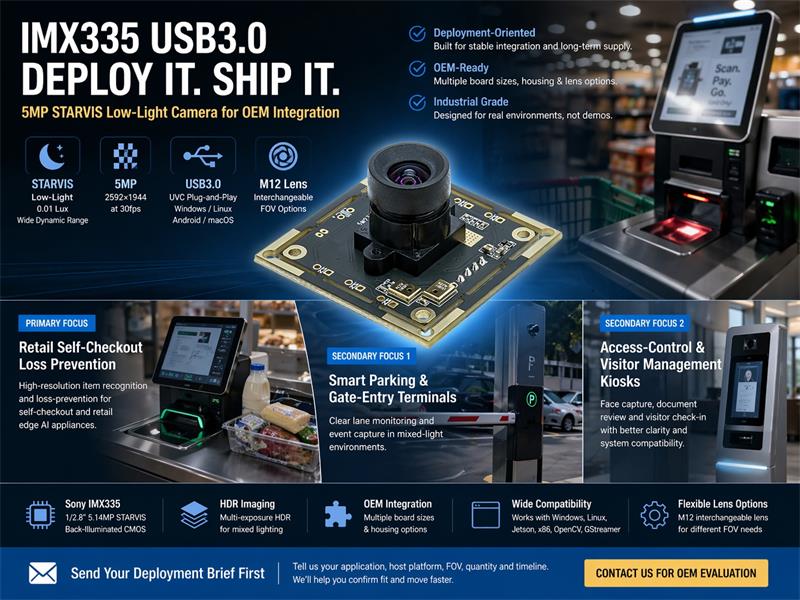
Built for OEM teams needing more usable image detail in real deployment, this 5MP USB3 camera fits retail terminals, parking systems, and access kiosks with HDR, UVC simplicity, and flexible lens options.
Goobuy UCM-IMX335 is a 5MP Sony STARVIS USB3.0 UVC camera built for self-checkout loss prevention, parking terminals, and access-control kiosks that need reliable low-light detail, HDR performance, and fast integration into real products.
Designed for deployment rather than demo-only evaluation, it combines 2592×1944 imaging, UVC plug-and-play compatibility, M12 interchangeable lens support, and practical OEM flexibility in board size, housing, and interface options. This makes it easier for product teams to add a higher-quality vision module to Windows, Linux, Jetson, x86, and edge AI hosts without turning the project into a full custom camera redesign
The strongest fit for this platform is not hobby vision or open-ended experimentation. It is for qualified OEM and system-integration teams building self-checkout loss prevention devices, item-recognition terminals, smart parking and gate-entry systems, and visitor or access kiosks where better image detail, mixed-light stability, and lower software friction directly improve deployment speed and repeat-order potential.
This is the strongest commercial fit for this camera.
Retail self-checkout and loss prevention are no longer just software problems. They are camera-placement, scene-quality, and edge-inference problems. Public industry material now explicitly frames self-checkout loss prevention around high resolution, dynamic range, customized lens options, USB-connected embedded vision, and compact durable design. That is almost the exact language this product should be sold in.
The UCM-IMX335 is especially relevant when a retail hardware OEM or SI partner needs:
This is also where your buyer language should be sharpest. The page should not say “good for retail analytics” in general. It should say:
That is the difference between broad traffic and real intent. Public retail AI material also shows that computer vision is being used precisely for Automated Self-Checkout, Loss Prevention, and store-side inference workflows
This is the second-best fit.
Parking and gate-entry systems often operate in exactly the kind of scene that breaks weak cameras: headlights, street lighting, lane shadows, reflective surfaces, and variable ambient light. Parking-lot management camera guidance from the market side emphasizes high sensitivity, HDR, and high resolution because one camera often has to cover more of the lane while still preserving useful detail for local review or analytics. North America’s smart parking market is also hardware-relevant, with hardware still representing the largest component in 2025 according to Grand View’s outlook.
This makes the UCM-IMX335 a good fit for:
The key is to sell it as a camera for terminals and local appliances, not as an outdoor final camera head. In other words, the most believable commercial story is:
a 5MP HDR USB3.0 camera for parking terminals, gate-entry kiosks, and lane-side review appliances
—not a generic “parking surveillance camera.” That keeps the message aligned with your real product form factor.
This is the third fit, and it is stronger than it sounds.
North America remains the largest kiosk market in the self-service category, and camera use inside kiosks is broadening from basic monitoring into QR / barcode capture, customer identification, document review, and security workflows. Public kiosk-camera guidance points to high dynamic range, high resolution, and fit-for-environment optics as key features. Visitor management and access-control buying language is also shifting toward identity, trust, logging, and integrated visual workflows.
This is where the UCM-IMX335 can be positioned as:
The buyer in this segment usually already has a kiosk controller, x86 box, or ARM host. They are less likely to ask for serializer chains or vehicle sync, and more likely to ask the questions you actually want:
That is much closer to a manageable OEM sales cycle
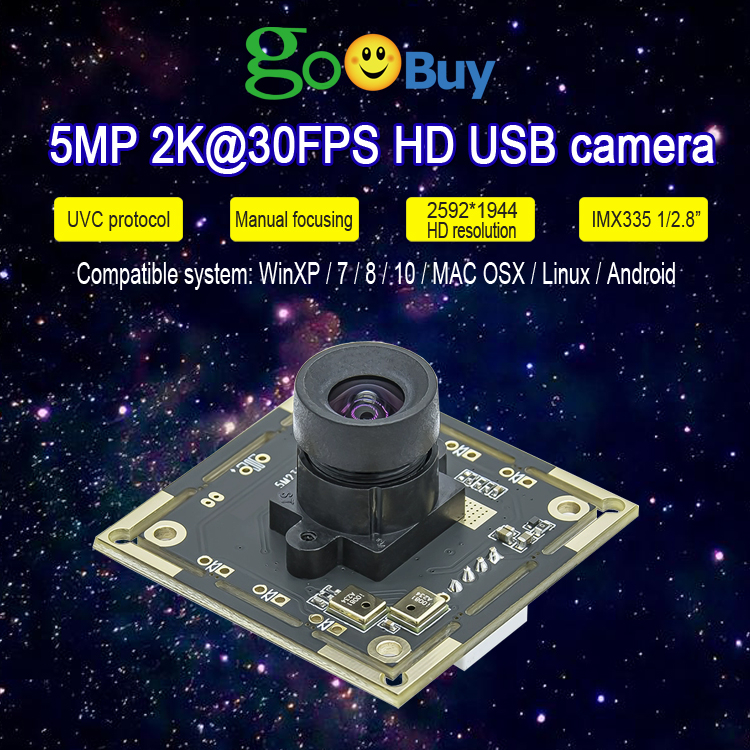


Integration & Compatibility
We support OEM/ODM customization:
A strong 5MP USB3 camera for self-checkout loss prevention is one that balances image detail, dynamic range, driver simplicity, and terminal integration. For checkout environments, the real need is usually reliable item-region visibility in mixed retail lighting, not just a higher number on a spec sheet. Public self-checkout vision guidance also emphasizes high resolution, dynamic range, customized lens options, USB connectivity, and compact durable design.
Yes—this is one of the most natural fits for the product. A 5MP UVC camera with USB3.0, M12 lens flexibility, and Windows/Linux compatibility is easier to evaluate inside retail AI appliances than a deeper custom camera interface. It is especially relevant where the buyer needs a compact camera behind a bezel or near a checkout zone.
Yes, provided the deployment model is right. The better fit is parking terminals, gate-entry kiosks, and lane-side review appliances, not fully exposed final outdoor camera heads. Parking-lot camera guidance from the market side explicitly points to high sensitivity, HDR, and high resolution as key needs in these environments.
Because the product form factor and interface already speak the language of kiosks and local appliances: USB3.0 UVC, M12 lens, standard host compatibility, and board/housing flexibility. Sony’s own IMX335 application language is surveillance, FA, and industrial cameras, not automotive sync chains or drone payload architectures.
Potentially yes, especially when the buyer needs more detail than a low-cost webcam but does not want a full custom camera project. The real decision factors are working distance, document size in frame, field of view, and lighting. Kiosk-camera guidance in the market already points to high resolution and HDR as important features for these kinds of terminal workflows.
Your current page already states that the module is UVC-compliant and works with Windows, Linux, macOS, Android, plus Jetson / x86 IPCs, and common toolchains such as OpenCV, GStreamer, and V4L2. That is exactly why it is stronger for deployment-oriented terminal projects than for highly specialized vehicle or flight systems.
The practical semi-custom range here is lens/FOV, board size, housing type, connector choice, and cable direction or length. That is usually enough for kiosk, parking, and retail-terminal OEMs that need deployment fit rather than a brand-new imaging architecture.
Send the deployment brief first: company, product type, target scene, host platform, required detail level, FOV, mounting distance, lighting condition, sample quantity, repeat quantity, and timeline. Buyers who provide this information early almost always get better recommendations faster. This brief-first logic is worth preserving from the Claude draft.
Before asking for pricing, send the deployment brief.
Please include:
That is the fastest way for us to judge whether the UCM-IMX335 is a strong fit.
This brief-first structure is worth keeping from the Claude draft; it is much better than letting unqualified buyers open with “price?” or “can you customize anything?”
Follow Me
Address:A615, 6F, Huachuangda Building, No107 Xinghua 1st Road, 43 District, Xinan street, Baoan, shenzhen, China 518101