

Shenzhen, China — July 4th, 2026 — Goobuy has begun a focused review of harsh-site monitoring challenges in mining conveyor and bulk-material handling environments, as part of its ongoing work around rugged camera heads, thermal imaging modules and industrial vision components for difficult operating conditions.
The review looked at publicly available safety reports, conveyor maintenance resources, industry articles, technical papers and field-oriented monitoring discussions related to mining, quarry, aggregate, cement and underground coal conveyor systems. The purpose was not to promote a single product category, but to better understand the field conditions that make conveyor monitoring difficult.
Across the reviewed materials, several recurring pain points appear consistently.
Hot idlers, seized rollers and bearing overheating remain among the most serious concerns. In harsh conveyor areas, a failed roller or bearing can create friction heat, especially when combined with coal fines, belt fibres, dust accumulation or poor access for inspection. Some regulator and safety sources also highlight that monitoring points and response procedures may not always detect early fire risk in time.
Belt mistracking is another repeated problem. When a conveyor belt does not run straight, it can lead to belt-edge wear, fugitive material, spillage, structural rubbing, additional cleanup work and possible friction-related safety concerns.
Spillage, carryback and material buildup are not only housekeeping issues. Material escaping from the belt or sticking to the return side can foul rollers, affect belt tracking, increase dust and create additional maintenance burden. In some cases, buildup around chutes, pulleys or transfer points can make inspection and cleaning more difficult.
Blocked chutes and plugged transfer points create both production and safety problems. A blockage may stop operation, but the larger concern is often how workers must inspect, clear or approach the equipment. Harsh conveyor environments can involve moving machinery, dust, restricted access and difficult visibility.
Manual inspection remains a major challenge. Long conveyor systems can have large numbers of rollers and difficult-to-access sections. Some reviewed sources describe manual belt walks as labor-intensive, time-consuming and sometimes limited by terrain, structures, weather or safety restrictions.
These findings suggest that harsh-site conveyor monitoring should begin with field conditions, not only with device specifications.
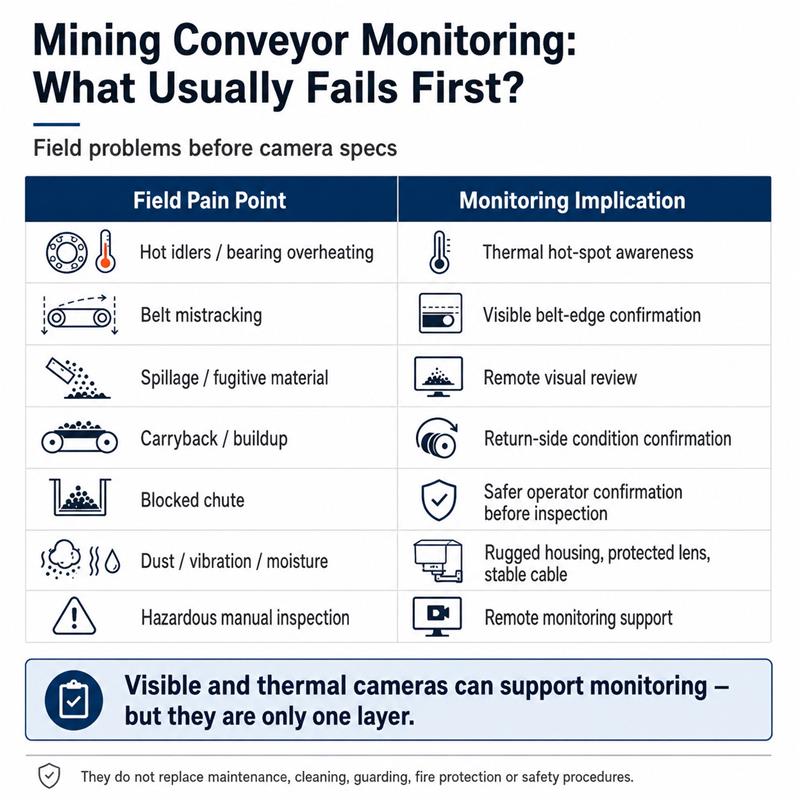
In some cases, visible cameras may support remote confirmation of belt position, spillage, carryback or chute blockage. Thermal imaging may support hot-spot awareness around idlers, rollers, bearings and pulley areas. Dual-spectrum approaches may be useful when both scene context and thermal abnormality need to be reviewed together.
However, Goobuy’s review also found that cameras should be treated as only one layer of a broader monitoring and maintenance workflow. They do not replace belt cleaning, mechanical alignment, guarding, lockout procedures, fire detection, suppression systems, SCADA logic or qualified maintenance work. The current evidence also does not support broad claims that low-light cameras, thermal cameras or SCADA video confirmation are already universal solutions for conveyor monitoring.
For system integrators, equipment builders and monitoring solution providers, the more practical starting questions may be:
What field problem needs to be confirmed?
Is the issue visual, thermal, mechanical or procedural?
Where can a camera or sensor be safely mounted?
Will dust, vibration, moisture or lens contamination affect reliability?
How will the information be used by maintenance teams, operators or control-room staff?
Goobuy will continue organizing these field observations into its harsh-environment monitoring knowledge base, with the goal of improving how rugged visual, thermal and dual-spectrum camera components are discussed, selected and validated for industrial equipment projects.
Goobuy is the camera brand of Shenzhen Novel Electronics Limited. The company supplies compact camera modules, rugged camera heads and configurable vision platforms for OEMs, equipment builders and system integrators. Its product work includes USB, AHD, PoE, thermal imaging, STARVIS low-light and IP-rated camera platforms for industrial and harsh-environment applications.

Follow Me
Address:A615, 6F, Huachuangda Building, No107 Xinghua 1st Road, 43 District, Xinan street, Baoan, shenzhen, China 518101