
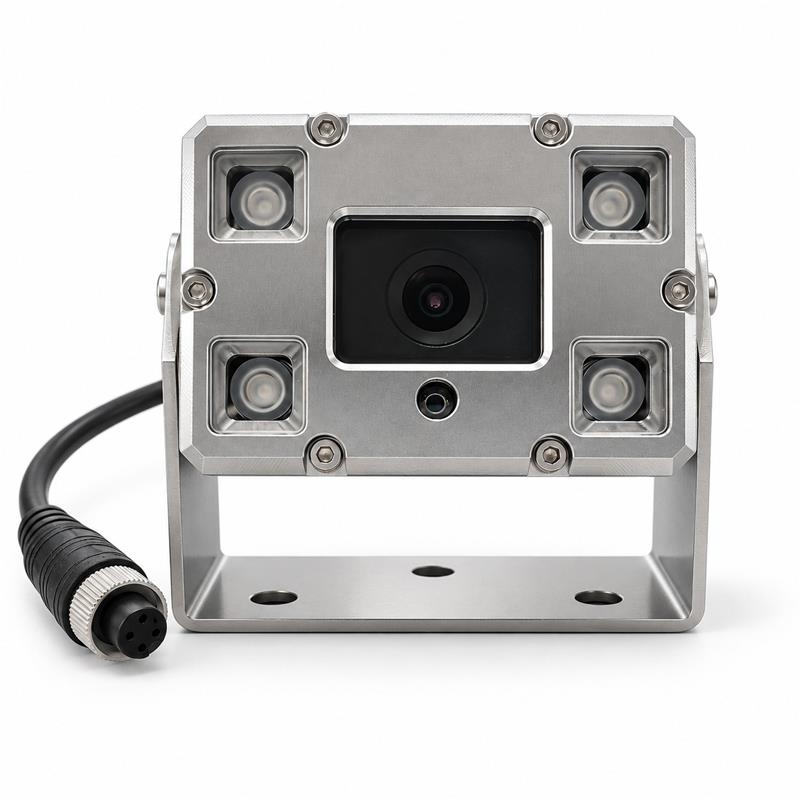
Sony IMX662 AHD camera goobuy AC-616 combines Sony’s 2.12MP STARVIS 2 image sensor with an image signal processor and analog-HD encoder to deliver 1080P video over conventional coaxial wiring. For heavy equipment, trucks, mining machines and harsh-site retrofit systems, this architecture is useful when low-light imaging, low-latency local video, direct AHD monitor or DVR compatibility and longer cable runs are more important than USB or IP networking. When the camera is built into a rugged stainless steel housing, it can also be adapted for exposed, wet and corrosive equipment locations where ordinary light-duty camera housings may not be suitable.
Sony’s IMX662 is a Type 1/2.8 sensor with approximately 2.12 million effective pixels, 2.9 μm pixels, 1920 × 1080 recommended recording resolution, CSI-2 RAW output and STARVIS 2 back-illuminated pixel technology. Sony also specifies Digital Overlap HDR and Clear HDR capabilities at the sensor level
The Sony IMX662 itself is not an AHD-output sensor.
At the sensor level, IMX662 outputs digital RAW data over CSI-2. To create an AHD camera, the sensor must be combined with downstream image processing and analog-HD encoding.
A simplified architecture is:
Sony IMX662 Sensor
→ ISP / Image Processing
→ AHD Encoder
→ Coaxial Video Output
→ AHD Monitor or DVR
This distinction matters because the image sensor and the transmission interface solve different parts of the system.
The IMX662 determines the core imaging potential, including low-light sensitivity, dynamic range and sensor-level HDR capability. The ISP and analog-HD encoder determine how that image is processed and delivered into an AHD ecosystem.
Commercial IMX662-based camera platforms with AHD output already exist. Current technical documentation shows IMX662 camera boards supporting AHD, TVI, CVI and CVBS analog output, with 1080p30/25 operation in HD analog modes
Heavy equipment cameras often operate under more difficult lighting conditions than conventional indoor CCTV.
A camera mounted on a loader, excavator, drill rig, haul truck or material handler may need to work through:
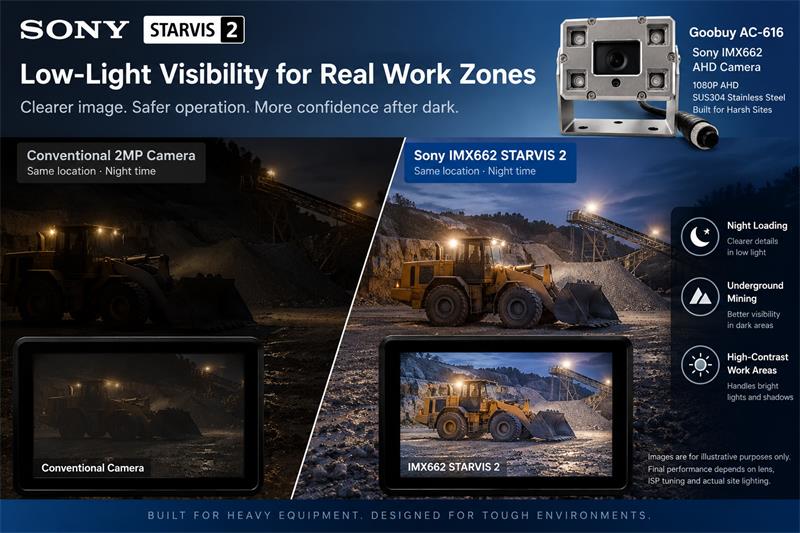
Sony developed STARVIS 2 for security and surveillance imaging where high sensitivity and wider dynamic range are important. The IMX662 uses a back-illuminated architecture and 2.9 μm pixels, and Sony specifies wider single-exposure dynamic range than the previous STARVIS generation at the same pixel size.
For heavy equipment, that matters because a camera does not operate in a controlled studio environment. It must handle real work zones where bright sky, reflective metal, headlights and deep machine shadows may all appear in the same scene.
Yes, the IMX662 is well suited to low-light camera designs, but the complete camera implementation still matters.
Sony specifies the IMX662 as a STARVIS 2 sensor designed for high sensitivity and low dark current. STARVIS 2 also improves dynamic range and near-infrared response compared with the earlier STARVIS generation.
In practical heavy-equipment use, that can help in applications such as:
However, a good sensor alone does not guarantee a good final camera.
Actual low-light image quality also depends on:
For this reason, low-light performance should always be validated on the complete camera, not inferred from the sensor name alone.
A generic 2MP AHD camera may provide the same nominal 1920 × 1080 resolution.
That does not mean it provides the same image quality in difficult lighting.
The IMX662 adds value through:
Sony explains that Clear HDR captures high-gain and low-gain signals simultaneously, helping reduce artifacts that can appear when sequential HDR exposures are combined in moving scenes.
That is particularly relevant in mobile equipment, because both the machine and surrounding objects may be moving.
Important engineering note:
The IMX662 sensor supports these capabilities, but the final camera must implement them correctly in the ISP. Sensor-level support does not automatically mean every IMX662 AHD camera provides the same HDR performance.
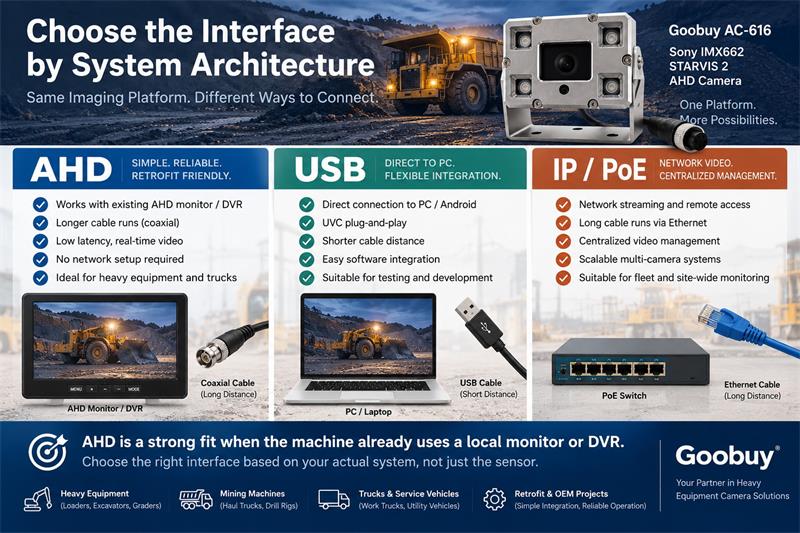
AHD is not the newest camera interface, but it still solves a very practical problem in heavy equipment.
Many machines already use:
In these systems, moving to IP or USB may add complexity without creating enough operational value.
An AHD camera can provide:
For a loader, excavator, truck or mining machine that already has an AHD monitor or DVR, AHD can be the lower-friction integration path.
The most important requirement is not the sensor model alone.
The truck monitor must support the camera’s actual video format and resolution.
Before connecting an IMX662 AHD camera to an existing truck monitor, confirm:
If the monitor only supports CVBS, an AHD camera may not work directly.
If the monitor supports AHD 1080P, then an IMX662-based 1080P AHD camera can be a strong retrofit candidate.
The correct engineering question is therefore:Does the existing monitor or DVR accept the same analog-HD format and resolution as the camera?
Neither architecture is universally better.
They solve different system requirements.
| Requirement | IMX662 AHD | IP / PoE |
|---|---|---|
| Low-latency local view | Strong | Network dependent |
| Existing AHD monitor / DVR | Strong | Weak |
| Long cable run | Strong | Strong |
| Simple retrofit | Strong | More setup |
| Network streaming | Weak | Strong |
| Remote access | Weak | Strong |
| Software integration | Limited | Strong |
| IP configuration required | No | Yes |
| Local machine display | Strong | Possible |
| Network switch required | No | Often |
Choose AHD when the machine already has a local monitor or DVR and the goal is reliable wired video with minimal system changes.
Choose IP / PoE when the project needs:
For many heavy-equipment retrofit projects, AHD remains attractive precisely because it does less.
The imaging platform is only one part of a harsh-site camera.
The housing determines whether the camera can survive the installation environment.
A SUS304 stainless steel housing can offer better resistance to moisture and corrosion than many conventional painted or light-duty housings.
This can be useful in:
For heavy equipment, the value is not cosmetic.
A stainless camera head can provide a more durable mechanical platform where the camera is exposed to:
However, several boundaries must remain clear:
SUS304 does not mean explosion-proof.
SUS304 does not mean ATEX or IECEx certified.
Stainless steel does not automatically mean IP69K.
The final environmental rating depends on the complete housing, seals, cable entry, connector and assembly validation.
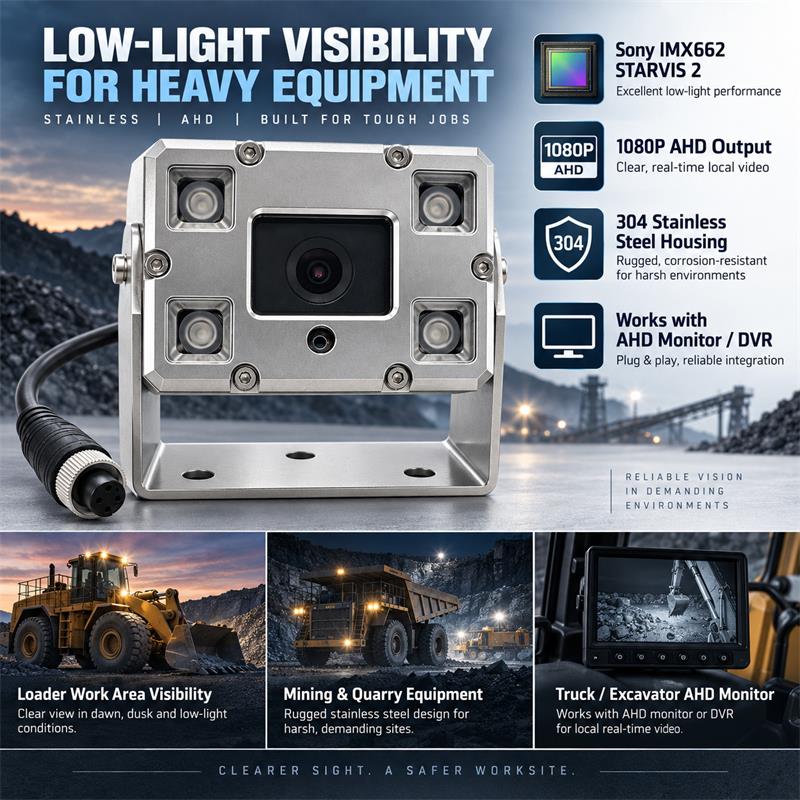
Yes. This is exactly the product direction represented by Goobuy AC-616.
The AC-616 combines:
The intended use is not generic indoor surveillance.
The product is positioned for:
where a conventional plastic or light-duty camera housing may be less suitable.
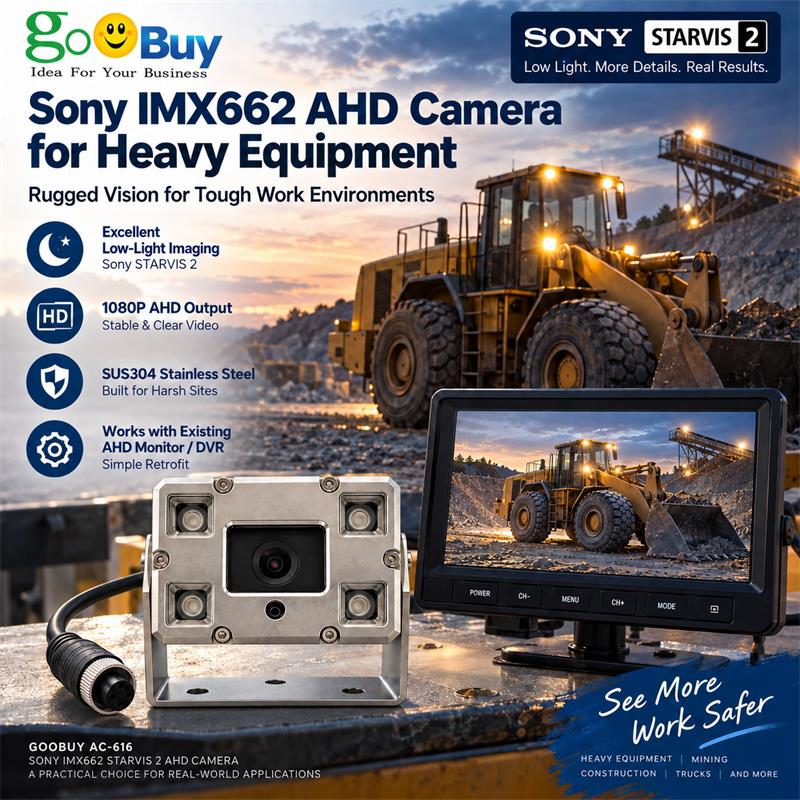
The Goobuy AC-616 is designed as a mature camera platform for customers who need the imaging benefits of Sony IMX662 together with a practical analog-HD interface and rugged stainless steel enclosure.
Core positioning:
Sony IMX662 STARVIS 2 + 1080P AHD + SUS304 Stainless Steel + Heavy Equipment
The product is best suited to systems where:
Lens, cable, connector and mounting details should be selected according to the actual machine.
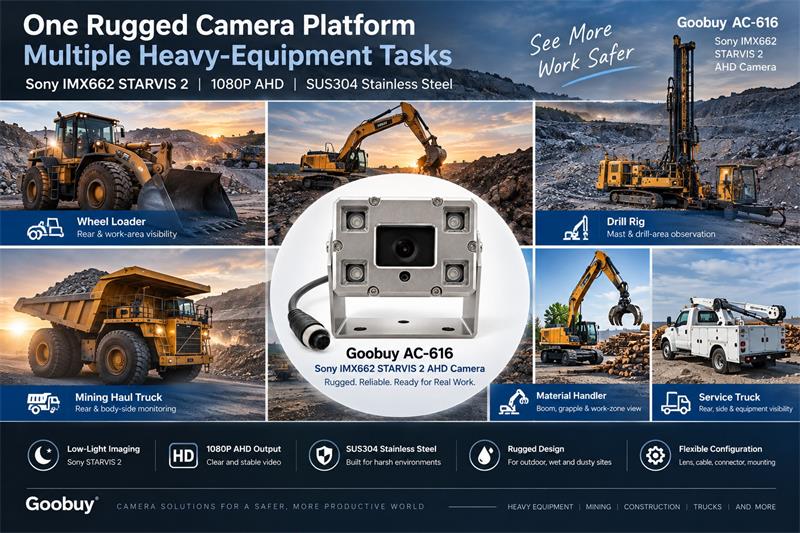
Rear and work-area visibility during loading, reversing and night operation.
Rear or right-side blind-zone observation.
Mast, drill area or process-point observation.
Boom, grapple and work-zone visibility.
Rear, body-side and service-area monitoring.
Blade or work-tool visibility.
Rear and work-zone camera positions exposed to dirt and washdown.
Rear and articulation-area visibility.
Truck applications are another strong fit.
A truck or service vehicle may already have:
In this case, a new IMX662 AHD camera can upgrade image quality without redesigning the entire video architecture.
Typical use includes:
The value is not limited to reversing.
A professional work vehicle may need cameras for:
A Sony IMX662 AHD camera goobuy AC-616 is best suited to heavy equipment, trucks and industrial vehicles that require 1080P low-light video over an existing analog-HD architecture. The Sony STARVIS 2 sensor provides strong low-light and HDR potential, while the AHD interface supports low-latency coaxial transmission to compatible monitors and DVRs. When integrated into a SUS304 stainless steel housing, the same platform can be used for mining, quarry, construction and harsh-site equipment where both imaging performance and mechanical durability matter.
For night mining use, the camera should be selected as a complete system, not by sensor alone.
A strong configuration should consider:
A Sony IMX662 AHD camera is a strong candidate when:
For extreme darkness, the system may still need:
A STARVIS 2 sensor improves low-light imaging, but it does not create light where none exists.
Professional buyers should separate sensor capability from complete-camera capability.
A camera using IMX662 does not automatically guarantee:
Each item depends on the actual camera design.
This distinction is particularly important when comparing low-cost product listings that use “IMX662” as a headline but provide little information about the downstream ISP, output format or environmental construction.
Before selecting a camera, define the system first.
Confirm AHD format and resolution.
Longer runs may influence cable and connector choices.
Rear, side, boom, mast or process-point positions require different optics.
This determines lens and FOV.
Night operation, underground use and partially lit areas require different validation.
Water, mud, dust, corrosion and washdown must be considered separately from image quality.
Existing machine harness compatibility is often more important than the camera PCB itself.
For professional heavy-equipment integration, the most reliable process is:
Test the target monitor or DVR.
Use the real camera position and working distance.
Test on the actual equipment if possible.
Avoid unnecessary harness redesign.
Check vibration, water path and installation geometry.
Use the camera under real machine conditions.
Then move to repeat production.
This is more reliable than selecting a camera only from a sensor name or online specification table.
No. The IMX662 is a digital CMOS image sensor with CSI-2 RAW output. An ISP and analog-HD encoder are required to generate AHD output.
Yes. Commercial IMX662 camera platforms are available with AHD, TVI, CVI and CVBS analog outputs when paired with a suitable ISP and encoder. Current technical documentation shows 1080p30/25 AHD implementations.
Cameras based on Sony IMX662 can use STARVIS 2 while also providing AHD output through a downstream encoder. Goobuy AC-616 is positioned around this architecture for heavy-equipment and harsh-site applications.
Yes. IMX662 uses Sony STARVIS 2 back-illuminated technology and is designed for high sensitivity and wider dynamic range. Final low-light performance still depends on lens, ISP tuning and the complete camera system.
Possibly, but compatibility must be checked. The monitor must support the camera’s AHD format, resolution and electrical interface. Connector pinout and power supply should also be confirmed.
Not universally. AHD is often better for simple low-latency local video and retrofit into existing monitor/DVR systems. IP is better when remote access, networking, centralized recording or software-side video management are required.
Yes. Goobuy AC-616 combines an IMX662 STARVIS 2 imaging platform, 1080P AHD output and SUS304 stainless steel housing for harsh-site equipment applications.
No. The sensor supports Clear HDR, but the complete camera ISP must implement and tune the feature correctly. Sensor support alone does not guarantee identical HDR performance across all IMX662 cameras.
It can be a strong option because of its low-light sensor architecture, but total darkness may still require work lights or IR illumination. The complete system should be tested under actual mine lighting conditions.
The most useful information is the existing monitor or DVR model, AHD format, cable length, mounting position, target distance, required field of view, night-lighting conditions, connector type and environmental requirement. With these details, the camera can usually be configured from an existing platform rather than starting a new development project.
Shenzhen Novel Electronics Limited / Goobuy provides customized camera solutions for heavy equipment security camera systems, off-highway vehicles, mining machinery, trucks, service vehicles and other harsh-site equipment worldwide. Our work focuses on practical camera integration around the customer's real machine architecture, including camera head, lens, cable, connector, housing, video interface and monitor or DVR compatibility.
Goobuy has particular experience with low-light camera platforms based on Sony STARVIS and STARVIS 2 image sensors, including IMX662 and other Sony low-light families. We support AHD, USB, PoE and rugged camera configurations and typically begin from mature existing camera platforms, then adjust optics, cable, connector, housing and mounting details for the customer's installation.
For heavy-equipment projects, our goal is not to add unnecessary system complexity. We help OEMs, equipment integrators, fleet service companies and retrofit specialists select a proven camera architecture, validate it on real equipment, and then lock a repeatable configuration for production.
Contact us right now:
email office@okgoobuy.com
whatsapp me: +86 13510914939
Follow Me
Address:A615, 6F, Huachuangda Building, No107 Xinghua 1st Road, 43 District, Xinan street, Baoan, shenzhen, China 518101