

Sony STARVIS 3 IMX908 is a compact 1/2.8-inch 4K HDR CMOS sensor with LOFIC pixel technology, designed for future low-light USB camera development where OEM devices need stronger night recognition, reduced highlight clipping, and fewer HDR motion artifacts under mixed lighting
Sony STARVIS 3 IMX908 is a 1/2.8-inch 8.4MP 4K CMOS image sensor with 1.45μm LOFIC pixels, designed for compact HDR security cameras, dashcams, edge AI devices, and future low-light USB camera development where high dynamic range, night recognition, and reduced HDR motion artifacts are more important than large-sensor pure sensitivity
Sony IMX908 is a new-generation STARVIS 3 CMOS image sensor developed for security camera applications. It uses Sony’s proprietary back-illuminated STARVIS 3 pixel technology and LOFIC pixel architecture. According to Sony, IMX908 is a 1/2.8-type sensor with approximately 8.4 effective megapixels, 4K resolution support, 1.45μm pixels, and up to 96dB HDR in single-shot exposure. Sony announced IMX908 in March 2026, with sample shipment planned for the end of March 2026.
For OEM product teams, IMX908 should not be treated only as a new Sony sensor name. It represents a clear direction for the next generation of compact low-light cameras: moving from simple brightness improvement toward high-dynamic-range night recognition.
In real applications, the difficult problem is not only darkness. Many cameras fail when dark areas, headlights, LED signs, glass reflections, entrances, tunnels, and moving people or vehicles appear in the same scene. IMX908 is designed for this type of high-contrast night environment.
2. Key Technical Parameters of Sony IMX908
| Parameter | Sony IMX908 |
|---|---|
| Sensor technology | Sony STARVIS 3 |
| Pixel architecture | Back-illuminated LOFIC pixel |
| Optical format | 1/2.8 inch |
| Effective pixels | Approx. 8.4MP |
| Resolution | 3856 × 2180, 4K compatible |
| Pixel size | 1.45μm |
| HDR capability | Up to 96dB |
| HDR modes | Clear HDR, Clear HDR3, Hybrid HDR3, DOL HDR |
| Shutter type | Rolling shutter |
| Frame rate | Up to 90fps at 10bit, 60fps at 12bit |
| Output interface | MIPI D-PHY |
| Target applications | Security cameras, dashcams, street monitoring, facility surveillance, edge AI vision devices |
Sony says the IMX908 uses STARVIS 3 LOFIC pixels to increase saturated charge capacity and improve low-light performance compared with conventional products, while reducing highlight blowout, shadow detail loss, noise, and HDR artifacts in high-contrast scenes.
Many low-light camera discussions focus only on brightness. For real OEM projects, brightness alone is not enough.
A useful night camera must handle:
The major value of STARVIS 3 IMX908 is its LOFIC-based HDR capability. With single-shot HDR, the sensor can preserve more highlight and shadow information without relying only on traditional multi-exposure HDR. For moving subjects, this can help reduce ghosting, motion artifacts, and recognition instability.
For AI vision systems, this matters because the camera is not only producing a beautiful image for human viewing. It must provide usable frames for detection, classification, recording, and evidence capture.
This is why IMX908 may become important for next-generation compact 4K HDR cameras used in security, fleet video, smart facilities, industrial monitoring, edge AI boxes, and embedded vision devices.
IMX908 should not be described as a direct replacement for every STARVIS 2 sensor.
Different Sony sensors still serve different camera-development paths.
| Project Requirement | Better Starting Point |
|---|---|
| Maximum large-sensor low-light image quality | IMX585 |
| Mature 4K USB/HDMI embedded camera platform | IMX678 |
| Compact 4K HDR recognition under difficult night lighting | IMX908 |
| 1080P low-light camera with lower development risk | IMX462 / IMX662 |
| High-speed motion capture or trigger-based vision | Global shutter sensor, not IMX908 |
IMX585 has a much larger 1/1.2-inch format and 2.9μm pixels, so it remains a strong choice when the project needs maximum low-light image quality and the product can accept a larger optical design.
IMX678 is more practical when the customer needs a mature 4K embedded camera platform with USB, HDMI, autofocus, CS lens, compact board, or faster sample validation.
IMX908 becomes more attractive when the project needs a smaller 4K sensor with strong HDR performance, reduced highlight clipping, and better recognition in night scenes with mixed lighting.
In short: choose IMX585 for large-format low-light image quality, IMX678 for mature 4K camera platform development, and IMX908 for future compact 4K STARVIS 3 HDR recognition projects.
Goobuy is not only tracking STARVIS 3 as a sensor-news topic. We already provide and develop multiple Sony STARVIS and STARVIS 2 camera module platforms for low-light, embedded vision, industrial monitoring, security, and OEM camera applications.
Our current and existing Sony-based camera module experience includes:
This existing STARVIS and STARVIS 2 product line gives Goobuy a practical foundation to evaluate IMX908. We do not look at IMX908 only as a sensor datasheet. We look at it as part of a real camera-development roadmap involving sensor board design, MIPI-to-USB architecture, ISP tuning, lens matching, HDR strategy, thermal validation, housing design, cable, connector, UVC output, and OEM sample testing.
For customers who need a camera solution now, Goobuy may recommend an existing STARVIS 2 platform such as IMX678, IMX585, IMX662, or IMX462. For customers planning a 2026–2027 next-generation product, we can help evaluate whether a future STARVIS 3 IMX908 NRE development path is realistic.
As of now, Sony has announced IMX908 and planned sample shipment in March 2026, but there is no widely confirmed public timetable showing large-scale mass production or broad commercial camera-module availability. Therefore, IMX908 should currently be treated as a future-facing sensor platform rather than a mature off-the-shelf USB camera module.
This distinction is important for OEM customers.
If your project needs immediate sample testing, faster validation, and lower development risk, an existing STARVIS 2 camera module such as IMX678 or IMX585 may be more practical.
If your product roadmap targets next-generation low-light HDR performance and can support a custom development cycle, IMX908 may become an important candidate for future NRE camera-module development.
Goobuy will continue tracking STARVIS 3 sensor availability, engineering access, ecosystem support, bridge-chip compatibility, ISP development, lens matching, and commercial feasibility. Once IMX908 becomes realistic for qualified engineering projects, we can help customers evaluate and develop differentiated IMX908 camera modules as early as possible.
When IMX908 becomes available for qualified camera-development projects, Goobuy can support customers in turning the sensor concept into a differentiated camera module.
A future IMX908 NRE development path may include:
IMX908 is a MIPI image sensor, not a direct USB camera. For a USB camera module, the development must evaluate MIPI-to-USB bridge architecture, USB2.0 or USB3.0 bandwidth, UVC compatibility, frame-rate targets, firmware stability, and host-device requirements.
The value of STARVIS 3 depends heavily on HDR pipeline tuning. Goobuy can help evaluate whether the project should prioritize human-viewable image quality, AI recognition, license plate readability, entrance monitoring, face detail, vehicle capture, or night evidence recording.
Low-light performance is not decided by the sensor alone. Lens aperture, FOV, distortion, IR-cut filter, NIR illumination, housing window, optical alignment, and working distance all affect final image quality. Goobuy can help customers select lens and optical configurations based on real application scenes.
Future IMX908 modules may require different board sizes, connector directions, FPC layouts, metal housing, mounting holes, USB cable exits, waterproof structure, or screw-lock connector options. Goobuy can evaluate these requirements during the NRE stage.
For customers with an existing host device, Goobuy can help evaluate USB camera naming, VID/PID, UVC descriptors, output format, resolution options, frame-rate modes, exposure behavior, and operating system compatibility.
If IMX908 is too early, too costly, or unnecessary for the customer’s schedule, Goobuy may recommend starting with an existing IMX678, IMX585, IMX662, or IMX462 platform first. This allows the customer to validate optical requirements, software workflow, host compatibility, housing design, and real market demand before investing in a future STARVIS 3 NRE project.
This is the practical difference between reading a sensor announcement and building a camera product.
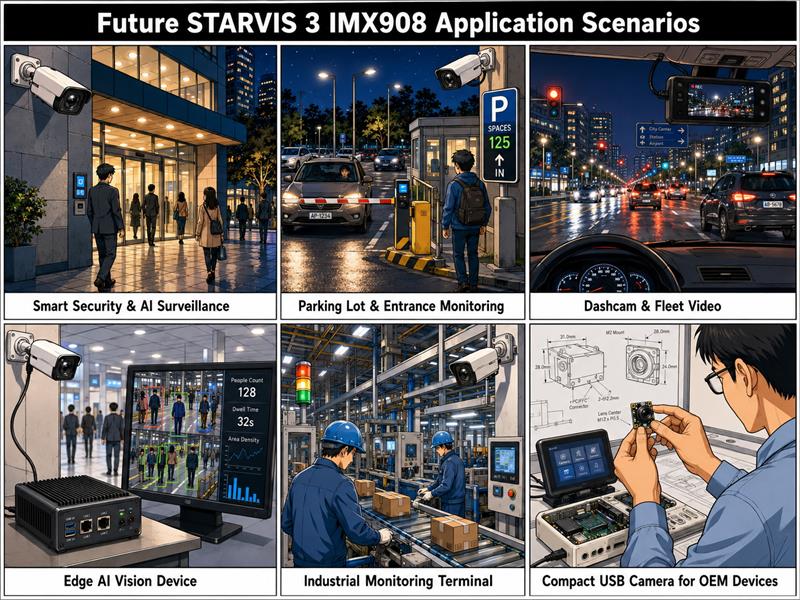
IMX908 may be useful for customers developing compact 4K HDR cameras for:
For entrances, parking lots, warehouses, retail stores, building lobbies, and public facilities where dark areas and strong lights appear together.
For night roads, headlights, tunnels, rain reflections, traffic-light areas, and moving vehicles where traditional HDR may create ghosting or overexposure.
For embedded AI systems that need stable object detection, people recognition, vehicle classification, or event recording under difficult lighting.
For factory passages, equipment entrances, logistics lines, machine enclosures, and control terminals where lighting is inconsistent.
For OEM devices that already have a host processor, USB input, display system, edge AI box, industrial PC, or embedded controller, but need a compact low-light camera head instead of a generic webcam.
A professional camera supplier should also explain when not to use a sensor.
IMX908 may not be the best starting point if:
For high-speed robotic motion capture, visual odometry, trigger-based machine vision, barcode reading on fast-moving parts, or precision measurement, a global shutter USB camera may be a better choice than IMX908.
For a qualified OEM project, Goobuy would not start from the sensor name alone.
We would first evaluate:
If IMX908 is suitable and sensor access is realistic, the project may move into a paid NRE path, including sensor board development, MIPI-to-USB conversion, firmware adaptation, ISP tuning, lens validation, mechanical configuration, sample production, and production feasibility review.
If IMX908 is not yet practical for the customer’s schedule, Goobuy may recommend a current STARVIS 2 camera platform first, then reserve a STARVIS 3 upgrade path for the next product generation.
If you are a product manager planning a new low-light camera product, do not choose IMX908 only because it is the newest STARVIS 3 sensor.
Choose IMX908 when your project truly needs:
Choose IMX585 when your project needs:
Choose IMX678 when your project needs:
Choose a global shutter camera when your project needs:
12. Can You Buy a Standalone Sony STARVIS 3 IMX908 Camera Now?
Many buyers searching for a “Sony STARVIS 3 standalone camera” are not looking for only the IMX908 image sensor datasheet. They want to know whether a complete camera module, USB camera, HDMI camera, PoE camera or board-level camera based on Sony STARVIS 3 is already available for real product testing.
As of the early IMX908 market stage, STARVIS 3 should be treated mainly as a next-generation camera development direction, not as a mature off-the-shelf camera platform for most OEM buyers. A production-ready standalone IMX908 camera still requires sensor sourcing, MIPI architecture, ISP tuning, firmware, lens matching, housing design, thermal validation, interface conversion and production testing.
For customers who need camera samples now, Goobuy usually recommends starting with mature STARVIS or STARVIS 2 platforms such as IMX678, IMX585, IMX415, IMX335, IMX662 or IMX462. For customers planning a 2026–2027 next-generation HDR camera product and able to support NRE development, IMX908 / STARVIS 3 can be discussed as a future custom camera-module path.
Goobuy helps OEM teams turn Sony STARVIS sensor selection into practical USB camera development.
If you are planning a next-generation low-light USB camera for 2026–2027, please send us your project background, including your host device, target resolution, frame rate, interface, lighting condition, FOV, working distance, lens requirement, housing design, cable length, connector, sample schedule, estimated quantity, and whether your project can support paid NRE.
We can help evaluate whether IMX908, IMX585, IMX678, IMX662, IMX462, or another Sony STARVIS-based camera module is the most realistic starting point.
For customers with an existing host device and a real product roadmap, Goobuy can support both current STARVIS 2 camera module selection and future STARVIS 3 IMX908 custom camera development when the sensor becomes commercially practical.
Planning a future STARVIS 3 low-light USB camera? Share your host device, lighting problem, interface, lens, housing, and production plan with Goobuy. We can help you decide whether to start with a current STARVIS 2 platform or prepare for a future IMX908 NRE development path.
Follow Me
Address:A615, 6F, Huachuangda Building, No107 Xinghua 1st Road, 43 District, Xinan street, Baoan, shenzhen, China 518101