
Goobuy UC-501 15×15mm micro USB camera for robotics applications where installation space, cable routing, and payload limitations prevent the use of conventional industrial cameras. The UC-501 enables Eye-in-Hand vision, teleoperation imaging, dexterous hand development, and compact robot integration through a lightweight UVC-compatible design
How Robotics Teams Select a Micro USB Camera for Eye-in-Hand Vision
The Goobuy UC-501 is a 15×15mm micro USB camera designed for robotics engineers who need vision inside robot grippers, dexterous hands, teleoperation systems, autonomous mobile robots, and compact AI devices where conventional cameras are too large to integrate. Instead of focusing solely on image resolution, the UC-501 addresses real-world engineering challenges such as limited installation space, cable routing constraints, payload restrictions, and rapid deployment requirements.
As robotic systems become smaller, lighter, and more intelligent, camera selection is increasingly determined by integration feasibility rather than megapixel count. This article explains when a compact USB camera is the right choice, where it delivers value, and how robotics teams evaluate vision hardware during product development.
When engineers begin developing a robotic system, vision is usually one of the first requirements. However, many projects discover that selecting a camera is not simply a matter of image quality.
The challenge is integration.
A camera may provide excellent image performance, but if it cannot physically fit inside the robot, it becomes unusable.
Typical industrial cameras often have dimensions ranging from 29mm to 40mm or more. While suitable for factory inspection systems, these cameras are difficult to install inside:
Modern robotic systems are becoming increasingly space-constrained. Every millimeter matters.
In many projects, engineers face four common problems:
The available volume inside a robotic end effector is often extremely small.
A camera housing that appears compact on paper may still be too large once mounting brackets, connectors, and cables are considered.
Additional weight near the end of a robotic arm increases inertia and can reduce movement efficiency.
For collaborative robots and humanoid robots, minimizing payload at the wrist is especially important.
Robots contain moving joints.
Routing cables through these joints is often more difficult than installing the camera itself.
Large connectors and thick cables can create mechanical limitations during operation.
Many industrial cameras require proprietary SDKs, drivers, and software frameworks.
Engineering teams may spend weeks integrating hardware before collecting their first image.
For research groups, startups, and fast-moving robotics teams, this delay can significantly slow product development.
Historically, robots relied on cameras mounted above the workspace or attached to the robot body.
This approach works well for general observation but has limitations when robots need to interact with objects precisely.
As robotic manipulation becomes more sophisticated, many systems now use Eye-in-Hand Vision.
Eye-in-Hand Vision refers to a camera mounted near the robot gripper or end effector.
Instead of observing from a distance, the camera moves together with the robot and sees the environment from the same perspective as the manipulation tool.
Benefits include:
Eye-in-Hand Vision is now widely adopted in:
Because installation space near the gripper is extremely limited, compact camera modules become a practical requirement rather than a preference
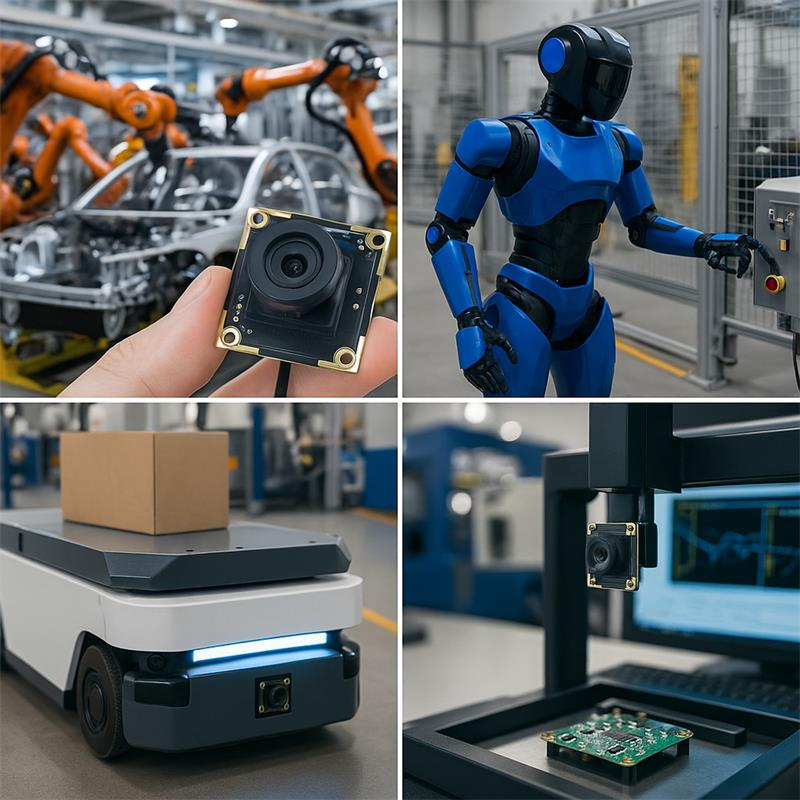
Not every robotic system requires a miniature camera.
However, there are several scenarios where compact vision hardware provides clear advantages.
Dexterous robotic hands require visual feedback close to the fingers.
External cameras often lose visibility during grasping operations because the robot itself blocks the field of view.
A miniature camera positioned near the fingers can provide:
As embodied AI development accelerates, finger-level vision is becoming increasingly valuable.
Teleoperation systems depend on human demonstrations.
The quality of collected training data often determines the success of downstream AI models.
A compact camera integrated into the manipulation area can capture:
This viewpoint often provides richer learning data than external cameras.
Humanoid robots require vision at multiple locations.
Head-mounted cameras provide environmental awareness, while wrist-mounted cameras support manipulation tasks.
Engineers developing humanoid platforms frequently need:
Miniature USB cameras can simplify early-stage prototyping and accelerate development cycles.
Autonomous mobile robots often include cameras for:
Available installation space inside robot chassis can be extremely limited.
A small camera module provides flexibility when mounting options are restricted.
Universities and research laboratories prioritize rapid experimentation.
Researchers typically prefer components that:
A UVC-compatible USB camera can often be connected and tested within minutes.
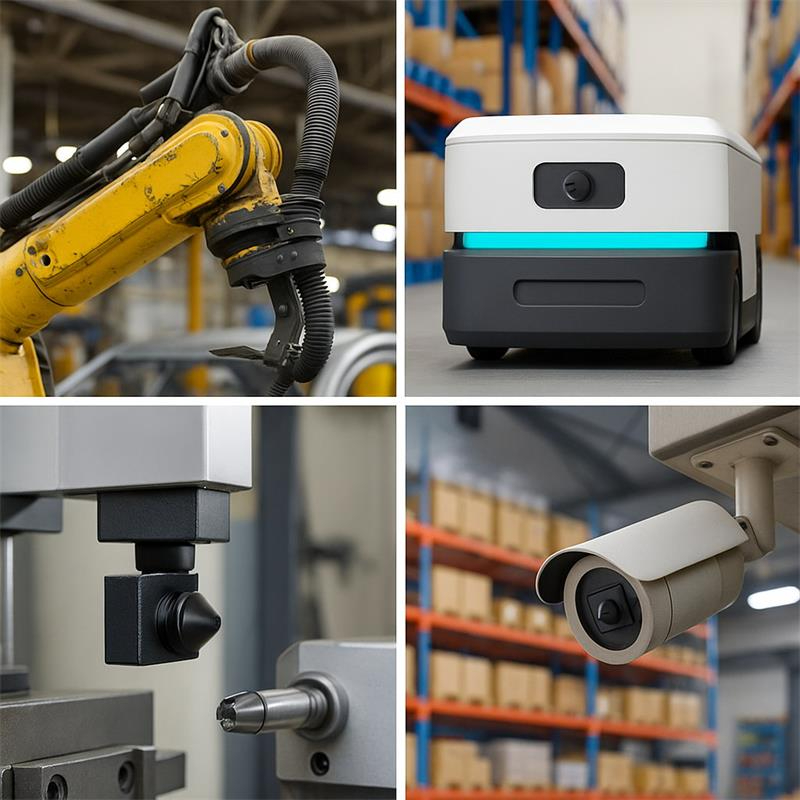
Before selecting a camera for a robotics project, engineers should evaluate more than image quality.
The following questions often determine long-term success.
Mechanical integration should be verified before evaluating image performance.
Reducing software complexity accelerates deployment.
Cable routing frequently becomes a hidden challenge in robotic systems.
Battery-powered platforms benefit from efficient hardware.
Linux compatibility remains important across robotics development environments.
Different tasks require different viewing angles.
Inspection tasks, manipulation tasks, and navigation tasks often need different optical configurations.
Robotics products often remain in production for many years.
Stable hardware availability reduces future redesign risk.
No camera is ideal for every application.
Understanding limitations is just as important as understanding strengths.
A compact USB camera may not be the best solution for the following scenarios.
Applications requiring:
often require specialized industrial vision cameras.
Measurement systems demanding micron-level accuracy generally require:
rather than compact embedded cameras.
Monitoring targets hundreds of meters away typically requires:
Traffic monitoring and vehicle identification systems generally require specialized imaging configurations optimized for long-distance capture.
Many camera discussions begin with resolution.
However, robotics engineers often evaluate a different question:
Can this camera be integrated quickly and reliably?
A camera that offers slightly lower image quality but integrates easily may create more value than a higher-resolution alternative that requires extensive mechanical redesign.
Successful robotics projects balance:
The best camera is not necessarily the one with the highest specifications.
It is the one that enables the robot to accomplish its task efficiently.
For many compact robotic platforms, integration constraints ultimately become the deciding factor.
As robotics systems become smaller, more capable, and increasingly focused on manipulation, vision hardware must evolve accordingly.
Compact USB cameras are no longer niche components.
They are becoming practical building blocks for:
For engineers facing strict space limitations, rapid deployment requirements, and complex mechanical constraints, camera selection is often less about maximizing specifications and more about minimizing integration risk.
Understanding these tradeoffs helps robotics teams choose vision systems that support both immediate prototyping and long-term product development.

Yes. Compact camera modules are commonly used in robotic grippers where installation space is limited.
Eye-in-Hand Vision places a camera near the robot end effector, allowing the robot to observe objects from the same perspective as the manipulation tool.
Most UVC-compatible USB cameras can be integrated into ROS environments with minimal configuration.
Yes. Compact cameras are frequently used in wrists, hands, and other space-constrained areas of humanoid robots.
Smaller cameras simplify installation, reduce payload, improve cable routing flexibility, and accelerate prototyping.
For many robotics applications, successful integration often has a greater impact on project success than resolution alone.
This Article is updated in June 5th, 2026 by Shenzhen Novel Electronics limited

Follow Me
Address:A615, 6F, Huachuangda Building, No107 Xinghua 1st Road, 43 District, Xinan street, Baoan, shenzhen, China 518101