
Sony IMX908 STARVIS 3 does not simply “end motion blur.” Its key value is reducing HDR ghosting caused by multi-exposure stitching, using LOFIC-based single-exposure HDR at the sensor level to preserve bright and dark scene information from the same moment for night AI vision.
Sony IMX908 STARVIS 3 Anti-Ghosting HDR for Night AI Vision
Low-light camera discussions often start with one simple question:
Can the camera see better at night?
For many modern AI vision systems, that question is no longer enough.
The harder problem is not pure darkness. It is darkness combined with strong local light, reflective surfaces, and moving subjects.
A real night scene may include vehicle headlights, LED signs, glass reflections, tunnel exits, entrance lighting, wet road reflections, walking people, moving vehicles, forklifts, AMRs, service robots, or teleoperation robots moving through uncontrolled lighting conditions.
In these scenes, a brighter image is not always a better image for recognition.
If a camera makes the scene brighter but creates ghosting, double edges, shifted outlines, or unstable object boundaries, the downstream AI system may still fail.
For human viewers, this may look like an image-quality issue.
For AI systems, it becomes a recognition-reliability issue.
Sony IMX908 is important because it represents Sony’s first public STARVIS 3 direction for compact 4K HDR security-oriented image sensors. Sony describes IMX908 as a 1/2.8-type, approximately 8.4MP 4K CMOS sensor using newly developed 1.45μm LOFIC pixels, with up to 96dB HDR at 4K resolution using a single exposure. Sony also states that this method can reduce artifacts and support more stable imaging of moving subjects compared with common multiple-exposure HDR methods.
However, IMX908 should currently be understood as a future-facing STARVIS 3 sensor direction, not a mature off-the-shelf USB camera module that is already widely available for every OEM project.
That distinction is important.
Many articles use “motion blur” and “ghosting” loosely. For camera engineers and OEM product teams, they are different problems.
| Problem | Main Cause | What It Looks Like | Can IMX908 Single-Exposure HDR Help? |
|---|---|---|---|
| Motion blur | Subject moves during exposure time | Soft, smeared object | Partly, only if exposure time, light, lens, and ISP allow faster capture |
| HDR ghosting | Short and long exposure frames are captured at different moments and stitched | Double edge, ghost trail, shifted outline | Yes, sensor-level single-exposure HDR can reduce this type of artifact |
| Rolling shutter distortion | Sensor rows are read at different times | Skewed, bent, or geometrically distorted objects | Not fully; IMX908 is still a rolling shutter sensor |
| ISP over-smoothing | High gain and aggressive denoising | Lost texture, waxy detail, weak AI features | Depends on ISP tuning and output pipeline |
This is the first key point:
IMX908 does not eliminate all motion blur. It mainly targets HDR ghosting caused by multi-exposure HDR stitching.
Motion blur happens when the subject moves during the exposure time. If a person, vehicle, robot, or robotic arm moves while the sensor is still collecting light, the object may look soft or smeared.
HDR ghosting is different. It happens when different exposures are captured at slightly different moments and then combined into one HDR frame. If the subject moves between those exposures, the final image may contain double edges or shifted object boundaries.
Rolling shutter is another separate issue. IMX908 is still a rolling shutter sensor, so very fast lateral motion or camera movement can still create skew or geometric distortion. For high-speed machine vision, robotic positioning, visual odometry, trigger-based inspection, or fast motion measurement, a global shutter sensor may still be required.
Traditional HDR often combines different exposure levels.
A short exposure protects highlights such as headlights, traffic lights, LED signs, and entrance lamps.
A longer exposure preserves darker areas such as road texture, clothing, vehicle bodies, human faces, warehouse aisles, or background shadows.
In a static scene, this can work well.
But in a moving night scene, the object may not stay in the same place between the short exposure and the long exposure.
That is where HDR ghosting appears.
Examples include:
The final HDR image may still look acceptable to a human viewer. But for AI recognition, the ghost edge can become a real problem.
For example, a pedestrian crossing in front of headlights may still be understandable to a human. But if the body edge is doubled by HDR stitching, an AI detector may shift the bounding box, lose tracking for several frames, or treat the ghost edge as a second object.
That is why anti-ghosting HDR matters more now than before.
Cameras are no longer only recording devices. They are increasingly used as input sensors for object detection, tracking, OCR, event analysis, robot perception, teleoperation, and evidence capture.
Sony describes STARVIS 3 as an evolution from STARVIS 2 that adopts LOFIC structure to expand dynamic range. Sony also states that STARVIS 3 offers a single-shot exposure dynamic range more than 20dB wider than STARVIS 2 pixels of the same size.
LOFIC means Lateral Overflow Integration Capacitor.
In simple terms, LOFIC gives the pixel extra capacity to handle strong light that would otherwise saturate the photodiode. Instead of losing highlight information too quickly, excess charge can be stored in an overflow capacitor.
At the sensor HDR capture level, this allows STARVIS 3 to preserve more highlight and shadow information from the same moment in time, instead of relying mainly on short and long exposures captured at different moments.
This is the anti-ghosting value.
If bright and dark information are captured from the same exposure moment, there is less temporal mismatch between exposure layers. That can reduce HDR ghosting around moving people, vehicles, robots, and other subjects in high-contrast night scenes.
However, this does not mean the entire camera system becomes free of all multi-frame processing. A complete camera product may still use ISP processing, temporal noise reduction, compression, AI preprocessing, or host-side enhancement. Final performance depends on the full imaging pipeline, not the sensor alone.
The final usable dynamic range in a camera product will still depend on:
So the accurate conclusion is:
IMX908 sensor-level single-exposure HDR may reduce multi-exposure HDR ghosting, but final product performance still depends on system-level camera engineering.
AI systems need stable visual features.
They need:
HDR ghosting can damage these features.
For object detection, a ghost edge may shift the bounding box.
For tracking, the object may appear unstable between frames.
For OCR, a license plate or label may become less readable.
For segmentation, artificial edges may confuse the boundary between object and background.
For robot perception, inconsistent frames can affect obstacle awareness or operator confidence.
This is why IMX908 should not only be described as a “better low-light sensor.”
A more useful description is:
a future STARVIS 3 sensor direction for preserving more useful image information under mixed lighting and motion.
Entrances are difficult because people move through mixed lighting.
A camera may need to capture a person walking through a doorway while outdoor daylight, indoor lighting, glass reflection, LED signage, or vehicle headlights appear in the same frame.
Multi-exposure HDR may create shifted outlines around the moving person. Sensor-level single-exposure HDR may reduce that type of ghosting.
Night parking and traffic scenes often combine headlights, traffic lights, reflective signs, wet ground, and moving vehicles.
If a camera is used only for passive viewing, some artifacts may be acceptable.
If the camera is used for AI detection, license plate region capture, pedestrian detection, or traffic event recognition, ghosting becomes more serious.
Dashcam scenes are extremely difficult:
Sony also positions IMX908 for security-camera-related applications including dashcams and facility monitoring, making the sensor direction relevant to high-contrast night mobility scenes.
Edge AI devices often care less about cinematic image quality and more about stable detection input.
If HDR ghosting creates false edges or unstable contours, the model may produce less reliable results.
For smart buildings, retail analytics, parking systems, logistics facilities, and industrial monitoring, anti-ghosting HDR may improve the usability of frames under difficult light.
Robots rarely move through controlled studio lighting.
A mobile robot may move from a dark warehouse aisle into a bright loading dock.
A service robot may pass glass doors, polished floors, LED displays, and moving people.
A teleoperation robot may turn from a dark corridor toward a bright doorway.
A humanoid robot may need to interpret people, vehicles, screens, doors, and reflective objects in one scene.
For robotics, IMX908 should not be confused with global-shutter motion capture. It is more relevant as a candidate for mixed-light awareness, teleoperation feedback, and night scene recognition, not as a replacement for global shutter sensors used in precision VIO, trigger capture, high-speed robotic measurement, or machine vision inspection.
The following application overview shows where IMX908 STARVIS 3 anti-ghosting HDR may become relevant: not only in low-light security cameras, but also in mixed-light AI vision systems where moving people, vehicles, robots, headlights, reflective surfaces, and fast exposure changes appear in the same scene
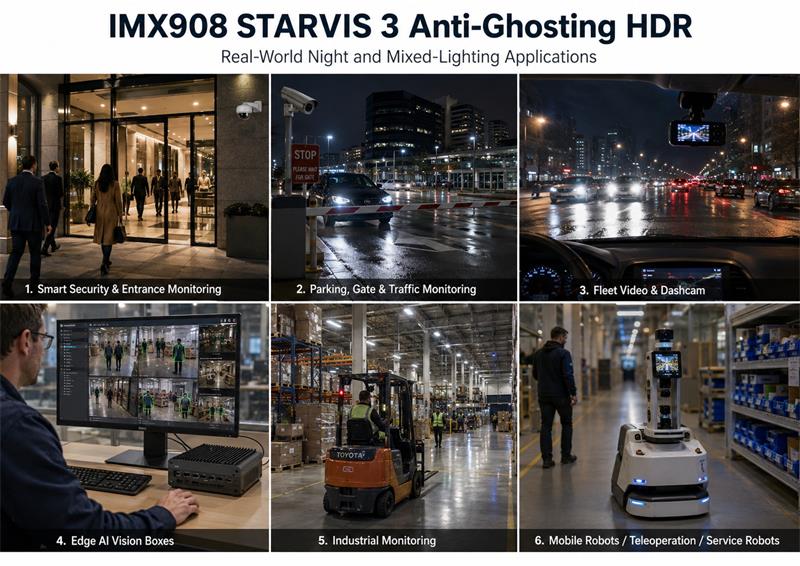
Real-world application scenarios for Sony IMX908 STARVIS 3 anti-ghosting HDR, showing how sensor-level single-exposure HDR may help reduce ghosting in night and mixed-light scenes with moving people, vehicles, robots, reflective surfaces, headlights, and LED lighting.
These scenarios do not mean IMX908 automatically solves every night-vision problem. Motion blur, rolling shutter distortion, ISP tuning, lens aperture, illumination, and host-side processing still matter. The key value of STARVIS 3 single-exposure HDR is reducing HDR ghosting caused by multi-exposure stitching in high-contrast moving scenes.
This table is useful for OEM teams that need to make a real decision, not just follow the newest sensor announcement.
| If Your Main Problem Is... | Better Starting Point |
|---|---|
| HDR ghosting in moving night scenes | Watch IMX908 / STARVIS 3 |
| Maximum 4K low-light image quality now | IMX585 |
| Mature 4K USB / HDMI sample validation now | IMX678 |
| 1080P low-light with lower bandwidth | IMX662 / IMX462 |
| Motion geometry, trigger, fast inspection | Global shutter USB camera |
| Immediate project validation with lower risk | Existing STARVIS 2 module first |
| Future product roadmap for compact anti-ghosting HDR | IMX908 feasibility evaluation later |
A professional camera selection process should not begin with:
Which sensor is newest?
It should begin with:
What problem must the camera solve?
IMX908 is interesting when the project needs compact 4K HDR imaging, reduced highlight clipping, fewer HDR artifacts, and better recognition reliability under mixed lighting.
It is especially relevant for future systems where moving subjects and high-contrast night scenes appear together.
But IMX908 is still early in the commercial camera-module ecosystem. Sony announced the sensor with planned sample shipment at the end of March 2026, but that does not mean mature USB camera modules are already broadly available for all OEM projects.
If the project mainly needs maximum low-light image quality from a larger 4K sensor, IMX585 remains a strong STARVIS 2 option.
Its larger sensor format and larger pixel size make it attractive for high-end night imaging, especially when the product can accept a larger optical design.
If the problem is pure darkness rather than HDR ghosting, IMX585 may still be the better starting point.
If the project needs a practical 4K camera module now, IMX678 may be more realistic than waiting for IMX908.
IMX678 is valuable because it can support near-term validation of:
For many OEM teams, the practical path is not waiting for a new STARVIS 3 ecosystem. It is validating the real product today with a mature STARVIS 2 platform, then preparing a future STARVIS 3 upgrade path.
check goobuy USB2.0 imx678 camera module here
Not every product needs 4K.
For applications where 1080P is enough, IMX662 or IMX462 may offer a more practical balance of low-light performance, bandwidth, cost, and integration stability.
They can be useful for embedded host devices, industrial monitoring terminals, night recording, and compact low-light video systems.
If the real issue is motion geometry, global shutter should be considered.
For trigger-based capture, barcode reading on moving objects, high-speed inspection, robotic positioning, visual odometry, or machine vision measurement, global shutter may be more important than STARVIS low-light HDR.
check goobuy imx462 usb camera module here
check goobuy imx662 usb camera module here
A rigorous article must explain the limits.
IMX908 single-exposure HDR may reduce HDR ghosting caused by multi-exposure stitching, but it cannot automatically solve every motion-related imaging problem.
It does not fully eliminate:
The final result depends on the complete imaging chain:
sensor + optics + lens aperture + FOV + IR filter + illumination + ISP + firmware + interface + host processing + AI model.
Single-exposure HDR is an important improvement, not a complete replacement for system-level engineering.
For near-term OEM development, existing STARVIS and STARVIS 2 modules are often more practical than waiting for a new STARVIS 3 ecosystem to mature.
Goobuy’s current camera module platforms are designed for this validation stage, including Sony STARVIS and STARVIS 2 options such as IMX678, IMX585, IMX662, IMX462, IMX335, IMX307, IMX291, and global shutter USB camera options.
These platforms can help OEM teams validate:
This is the realistic path for many product teams:
Use an existing STARVIS 2 platform to validate the product now. Monitor IMX908 as a future STARVIS 3 anti-ghosting HDR path when the ecosystem becomes mature enough for the project schedule.
For OEM teams with an existing host device, the right starting point may be an IMX678 or IMX585 sample validation today, while IMX908 remains a future STARVIS 3 anti-ghosting HDR path to monitor.
Before selecting IMX908 for a future camera project, OEM teams should ask:
These questions are more useful than asking only:
Is STARVIS 3 better than STARVIS 2?
The better question is:
Which sensor and camera pipeline fit the real application?
Sony IMX908 STARVIS 3 should not be described as the end of motion blur.
That would be too broad.
A more accurate conclusion is:
IMX908’s LOFIC-based single-exposure HDR can reduce HDR ghosting caused by multi-exposure stitching, especially in high-contrast night scenes with moving subjects.
This matters because modern cameras are increasingly used for recognition, not only recording.
For security, traffic, fleet video, edge AI, industrial monitoring, mobile robots, teleoperation robots, humanoid robots, and service robots, the future question may not be:
Which sensor sees brighter at night?
It may be:
Which imaging pipeline provides more reliable perception when the scene is dark, bright, reflective, moving, and unpredictable at the same time?
That is where STARVIS 3 becomes important.
And that is also why existing STARVIS 2 platforms such as IMX678 and IMX585 remain commercially valuable. They allow OEM teams to validate real products today, while preparing for future STARVIS 3 anti-ghosting HDR development when the ecosystem becomes more mature.
Professional FAQ
No. Sony IMX908 does not completely eliminate motion blur. Its main value is reducing HDR ghosting caused by multi-exposure HDR stitching. Motion blur still depends on exposure time, subject speed, lens aperture, illumination, gain, ISP tuning, and frame rate.
Motion blur happens when a subject moves during the exposure time, creating a soft or smeared object. HDR ghosting happens when short and long exposure frames are captured at different moments and stitched together, creating double edges or shifted outlines. IMX908 single-exposure HDR mainly helps reduce HDR ghosting, not all motion blur.
STARVIS 3 IMX908 uses LOFIC-based single-exposure HDR at the sensor level, so bright and dark information can be captured from the same exposure moment. This reduces the temporal mismatch that can occur when STARVIS 2 or traditional multi-exposure HDR combines short and long exposures captured at slightly different times.
IMX908 is not automatically better than IMX585. IMX908 is more interesting for compact 4K HDR scenes where anti-ghosting and mixed-light recognition matter. IMX585 remains a strong choice when the project needs larger-sensor 4K low-light image quality and does not require the most compact sensor format. check goobuy IMX585 USB3.0 camera module here
If the project needs immediate 4K USB or HDMI sample validation, IMX678 may be more practical because it is a mature STARVIS 2 platform. IMX908 should be monitored as a future STARVIS 3 anti-ghosting HDR path, especially if the project can support a longer development schedule and new sensor validation.
IMX908 may be suitable for robot scene awareness, teleoperation feedback, night monitoring, and mixed-light recognition. It should not be treated as a replacement for global shutter sensors in precision VIO, high-speed motion tracking, trigger-based capture, robotic measurement, or machine vision inspection.
HDR ghosting matters for AI vision because artificial double edges, shifted outlines, and unstable object boundaries can confuse detection, tracking, OCR, segmentation, and robot perception. A frame that looks acceptable to a human may still produce unstable results for an AI model.
No. Single-exposure HDR describes the sensor-level HDR capture method. A complete camera system may still use ISP processing, temporal noise reduction, compression, firmware control, host processing, or AI preprocessing. Final performance depends on the full imaging pipeline.
A global shutter camera should be chosen when geometric accuracy is more important than HDR anti-ghosting. Applications such as robotic positioning, trigger-based inspection, barcode reading on moving objects, high-speed conveyor monitoring, and motion measurement usually require global shutter rather than rolling shutter HDR.
An OEM team should provide the host device, operating system, interface requirement, target resolution and frame rate, lighting condition, moving-object speed, FOV, lens aperture, working distance, IR requirement, housing design, cable length, sample schedule, estimated quantity, and whether the project requires AI recognition, human viewing, evidence recording, or robotic awareness.

Follow Me
Address:A615, 6F, Huachuangda Building, No107 Xinghua 1st Road, 43 District, Xinan street, Baoan, shenzhen, China 518101