
The Goobuy Dual AR0234 USB-C Stereo Camera is a hardware-synchronized binocular camera platform featuring two 2MP global shutter sensors, dual 1080P imaging up to 60fps, and USB 2.0 UVC connectivity. Designed for OEM stereo vision systems, robotics, industrial 3D inspection, embedded AI devices, and machine vision equipment, it provides synchronized dual-camera image capture with configurable lens, FOV, focus distance, cable, housing, and mounting options for practical system integration
The Goobuy Dual AR0234 USB-C Stereo Camera is a binocular global shutter camera platform featuring two 2MP AR0234 sensors, hardware-synchronized dual 1080P imaging, and USB 2.0 UVC connectivity. Designed for robotics vision, stereo imaging, industrial inspection, 3D vision development, and embedded AI systems, it provides a practical dual-camera hardware solution for OEMs and system integrators.
The Goobuy Dual AR0234 USB-C Stereo Camera is an existing binocular camera platform built around two 2MP AR0234 color global shutter sensors.
Unlike a setup using two independent USB webcams, this camera supports hardware-synchronized image capture, allowing the left and right sensors to capture corresponding image frames at the same time.
The platform supports:
Dual 2MP AR0234 global shutter sensors
Synchronized dual 1080P imaging up to 60fps
Native USB-C physical connection
USB 2.0 UVC interface
MJPEG and YUY2 output formats
Driver-free UVC integration on compatible host systems
Adjustable lens focus distance
Compact integrated binocular camera structure
This camera is designed for companies that already have a host computer, embedded AI device, robotic platform, industrial inspection machine, or other equipment and need a synchronized stereo camera as part of their product.
It is an existing camera platform for practical integration and configuration, rather than a complete consumer depth camera or a from-zero custom development service.
Stereo vision uses two cameras positioned at different viewpoints to capture corresponding images of the same scene.
By comparing the left and right images, the host system can perform stereo matching, estimate depth information, identify object positions, and support spatial perception.
However, synchronization is particularly important when the camera or target object is moving.
If two independent cameras capture images at different moments, a moving object may appear in different positions in the two image streams. This timing mismatch can affect stereo matching and subsequent depth-related processing.
The Goobuy Dual AR0234 platform supports hardware-synchronized dual-camera imaging, providing corresponding image pairs for applications involving:
Moving objects
Robotic arms and mobile robots
Conveyor inspection
Industrial automation
Object positioning
Stereo vision development
Embedded machine perception
Hardware synchronization provides a more suitable camera foundation than two independent webcams for applications where image timing consistency matters.
The customer's host system and stereo-processing software are still responsible for image matching, depth calculation, and application-level results.
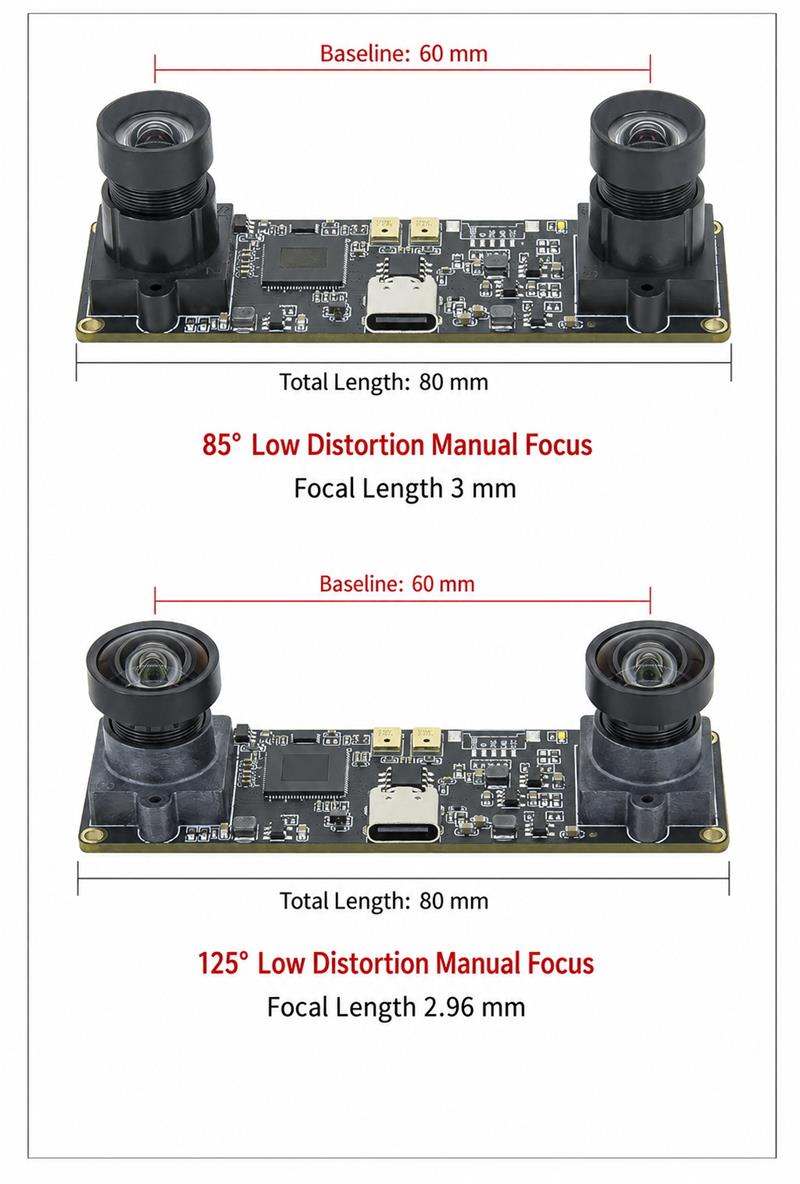
Both AR0234 sensors use global shutter technology.
Unlike rolling shutter sensors, which expose different image rows at different times, global shutter sensors capture the image frame simultaneously.
This is useful when recording moving objects, fast mechanical movement, robotic operations, or inspection processes involving motion.
For example:
A robot arm moving between inspection positions
Objects traveling along a conveyor belt
Mobile robotic platforms navigating an environment
Automated equipment capturing moving components
Industrial systems requiring synchronized binocular images
The combination of dual global shutter sensors and hardware synchronization makes this camera suitable for motion-sensitive stereo vision applications.
Actual imaging performance still depends on exposure settings, illumination, frame rate, host processing, and the customer's software pipeline.
Robotics platforms increasingly use stereo imaging to obtain visual information about their surrounding environment.
A binocular camera can provide two synchronized image streams for stereo matching and subsequent spatial analysis.
The Goobuy Dual AR0234 USB-C Camera can be evaluated for:
Mobile Robots
Synchronized stereo image capture for indoor mobile robots, autonomous platforms, and navigation-related vision systems.
Robotic Arms
Binocular imaging for object positioning, visual guidance, and inspection around robotic work areas.
Industrial Robots
Stereo image input for machine perception, object localization, and automated inspection.
Autonomous Equipment
Dual-camera image acquisition for embedded perception systems and environment observation.
OEM Robot Vision Devices
A compact synchronized camera platform for manufacturers integrating binocular vision into their own equipment.
The camera supplies synchronized image streams. Depth estimation, point-cloud generation, obstacle detection, and robot navigation require the appropriate host hardware and application software.
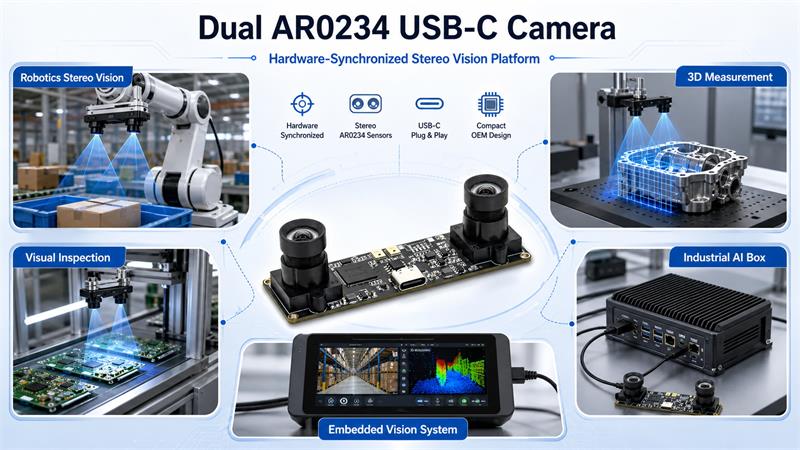
Stereo camera systems can also be used as an image acquisition component in industrial inspection and measurement equipment.
Potential applications include:
Industrial part positioning
Dimensional inspection development
Object alignment
Surface and shape inspection
Binocular visual inspection
Machine-mounted imaging systems
Spatial image acquisition for industrial AI
For these applications, the two image streams provide visual input for the customer's stereo-processing and measurement algorithms.
The actual measurement performance depends on several system-level factors:
Camera baseline distance
Lens selection and optical consistency
Working distance
Target object characteristics
Lighting conditions
Camera mounting stability
Host processing capability
Stereo matching and measurement algorithms
The Goobuy camera provides synchronized binocular image capture. Customers should validate the complete measurement system using their own mechanical structure, software, and application conditions.
It should not be considered a finished 3D measurement instrument with guaranteed measurement accuracy or ready-to-use point-cloud output.
The camera uses a native USB-C physical connector with a USB 2.0 UVC interface.
This combination allows integration with compatible embedded computers, industrial PCs, AI edge devices, and other host systems supporting USB video capture.
Typical integration environments include:
Embedded Linux computers
Industrial AI boxes
Windows-based industrial PCs
Compatible Android host devices
Robotics controllers
Machine vision computers
OEM electronic equipment
The UVC interface helps reduce dependence on proprietary camera drivers.
Available image formats include:
MJPEG
Suitable for higher-frame-rate dual-view image transmission within the supported USB bandwidth.
YUY2
Uncompressed image output for applications that require this format, generally at lower frame rates.
For synchronized dual 1080P 60fps operation, MJPEG is the primary high-frame-rate output mode. YUY2 operates at lower frame rates.
Actual performance depends on the host USB controller, available bandwidth, operating system, capture software, decoding workload, cable configuration, and image settings.
Customers should evaluate the camera on their actual host system before confirming the final configuration.
The Goobuy Dual AR0234 platform is an existing binocular camera design. Practical configuration can be reviewed around the current hardware structure.
Available configuration areas include:
Lens and Field of View
The standard optical configuration can be evaluated against the customer's required viewing angle, target size, and working distance.
Focus Distance
The lenses can be rotated for focus adjustment. The standard focus range is approximately 30cm to infinity, depending on the optical setup.
USB-C Cable
Cable length, routing, and connector orientation can be reviewed according to the host device and enclosure.
Mechanical Mounting
Mounting and housing requirements can be evaluated against the existing board dimensions and physical camera arrangement.
USB Device Identification
Hardware device name and USB descriptor requirements can be reviewed for compatible OEM applications, subject to firmware feasibility.
Production Configuration
Approved lens, focus, cable, connector, mounting, labeling, and packaging details can be documented for repeatable small-batch production.
The current PCB does not support adding an onboard LED illumination board directly.
External illumination or separate housing-level lighting can be considered as a separate system requirement.
Changes to PCB layout, camera baseline, special firmware, private tooling, or substantial mechanical redesign require separate feasibility, cost, MOQ, and NRE evaluation.
For customers who already have an embedded Linux host, industrial computer, or AI box, the standard camera can be evaluated through its native USB-C connection and UVC interface.
Cable length, connector orientation, mounting, and host compatibility can be reviewed before sample approval.
For robotics manufacturers requiring synchronized binocular images, the dual AR0234 platform provides a ready-made hardware starting point.
The customer's robotics software can process the left and right images for stereo matching, spatial perception, and object positioning.
For inspection equipment manufacturers, the camera can be evaluated according to working distance, field of view, mounting structure, target size, illumination, and host software.
For system integrators and equipment manufacturers, Goobuy can record the approved hardware configuration to help maintain consistency across subsequent sample and production batches.
This is particularly useful when the same camera is integrated into multiple equipment units or repeated installations.
| Item | Specification |
|---|---|
| Product Type | Dual AR0234 USB-C Stereo Camera |
| Sensor | Dual AR0234 |
| Sensor Size | 1/2.6" |
| Resolution | Dual 2MP / Dual 1080P |
| Maximum Output | Up to 3840 × 1200 dual-view output |
| Standard Stereo Mode | Hardware-synchronized dual 1080P 60fps |
| Shutter Type | Global Shutter |
| Image Type | Color |
| Interface | Native USB-C |
| USB Standard | USB 2.0 UVC |
| Driver | UVC driver-free integration |
| Output Formats | MJPEG / YUY2 |
| Focus | Fixed-focus lens, mechanically adjustable |
| Focus Adjustment | Lens rotation |
| Object Distance | Approximately 30cm to infinity, adjustable |
| Standard FOV | D=85° |
| EFL | 4.1mm |
| F/No. | F3.0 |
| Lens Construction | 2G + 3P |
| TV Distortion | -1% |
| Module Dimensions | 80 × 25 × 23.8 ±0.5mm |
| Power Supply | USB bus power |
| Supply Voltage | DC 5V ±5% |
| Maximum Power Consumption | 1200mW |
| S/N Ratio | 38dB |
| Dynamic Range | 71.4dB |
| AGC / AEC / White Balance | Auto |
| Operating Temperature | -20°C to +70°C |
| Stable Image Temperature | 0°C to +50°C |
| Onboard LED Board | Not supported on current PCB |
| Operating Systems | Windows / macOS / Linux / Android with UVC support |
| Certifications | FCC / CE / RoHS |
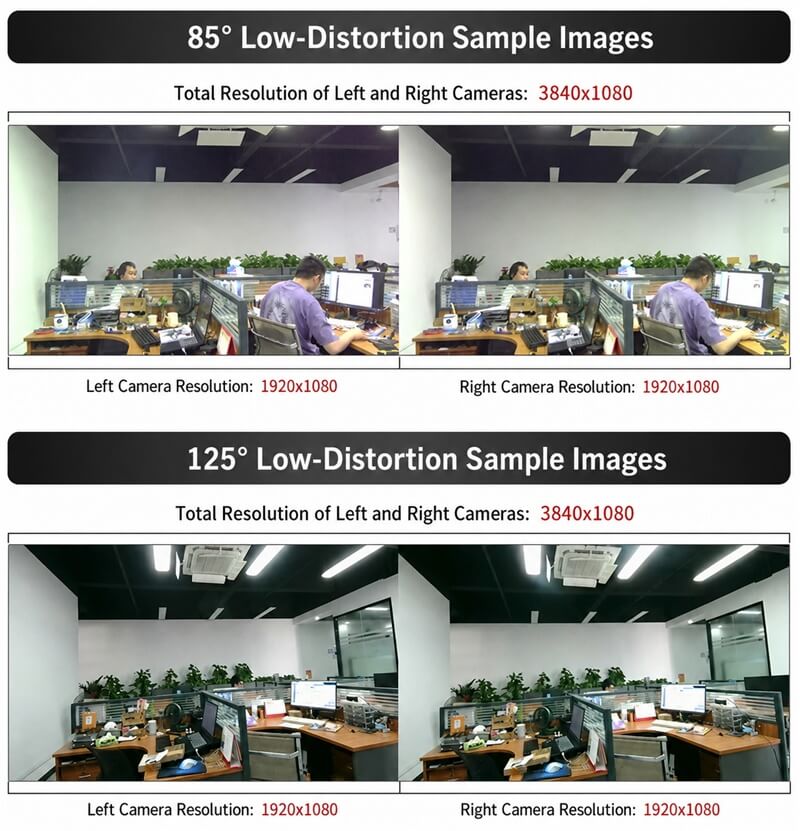
Frame Rate and Host Compatibility Note
High-frame-rate synchronized dual-view output is primarily supported through MJPEG. YUY2 uncompressed output is available at lower frame rates.
Actual frame rate, latency, decoding load, and stability should be confirmed with the customer's host system, USB bandwidth, software pipeline, and required image settings.
Before selecting a binocular camera for an OEM or industrial application, it is useful to confirm several key points.
1. Synchronization
Do you require hardware-synchronized image capture, or are two independent camera streams sufficient?
2. Sensor Type
Does the application involve moving objects or equipment where global shutter imaging is important?
3. Field of View
What is the required viewing angle, target size, and camera-to-object distance?
4. Baseline Distance
Does the standard physical distance between the two camera viewpoints fit your intended stereo application?
5. Interface
Does your host system support USB 2.0 UVC capture through a USB-C connection?
6. Image Format
Do you need MJPEG for higher frame rates or YUY2 for uncompressed image data?
7. Processing Software
Will your system perform its own stereo matching, depth estimation, and image processing?
8. Mechanical Integration
What are the required cable length, mounting position, housing dimensions, and connector direction?
Confirming these details before purchasing samples can help reduce unnecessary integration work.
Yes. The two AR0234 global shutter sensors support hardware-synchronized dual-camera image capture.
This is important for stereo vision applications involving moving objects, robotics, industrial inspection, and binocular image processing.
Yes. The platform supports synchronized dual 1080P 60fps imaging through its high-frame-rate MJPEG output mode.
Actual performance depends on USB bandwidth, host processing, software capture method, decoding capability, and configuration.
YUY2 uncompressed output is available at lower frame rates.
It is a USB 2.0 UVC camera with a native USB-C physical connector.
USB-C describes the connector type, not the USB data-transfer generation.
Yes. Both camera sensors are AR0234 global shutter sensors.
Global shutter imaging is useful for moving objects, robotic motion, conveyor inspection, and other applications where rolling shutter distortion may be undesirable.
No. The standard camera provides synchronized left and right image streams.
Depth maps, point clouds, 3D reconstruction, and object-position information require additional stereo-processing software and suitable host computing hardware.
Customers should confirm their software and processing requirements before selecting the camera.
Yes. It can be evaluated as a synchronized binocular image source for mobile robots, robotic arms, industrial robots, and embedded perception systems.
The customer's application software is responsible for stereo matching, depth processing, navigation, and other perception functions.
Yes. The camera can serve as an image acquisition component in industrial inspection and stereo vision development.
Final measurement performance depends on the complete optical, mechanical, lighting, processing, and software configuration.
The camera uses USB 2.0 UVC, allowing integration with compatible Linux and Android host devices.
Actual compatibility depends on the host USB implementation, UVC support, available bandwidth, and application software.
Sample testing with the intended host system is recommended.
Yes. The lens can be rotated for mechanical focus adjustment.
The standard object distance is approximately 30cm to infinity, depending on the lens configuration.
For stereo applications, both optical channels should be evaluated together after focus adjustment.
The standard camera uses an existing board-level physical arrangement.
Changing the baseline distance may require PCB, mechanical, housing, and system-level modifications. Such requirements need separate feasibility, cost, MOQ, and development-time evaluation.
For most customers, evaluating the standard platform first is the more practical approach.
No. The current PCB does not support direct installation of an onboard LED illumination board.
External illumination or a separate lighting arrangement may be evaluated according to the application.
Yes. Goobuy can review practical configurations based on the existing camera platform, including lens, focus distance, USB-C cable, mounting, housing, device identification, labeling, and packaging.
Major PCB, firmware, baseline, or mechanical changes require separate engineering review.
Goobuy, operated by Shenzhen Novel Electronics Limited, specializes in compact USB cameras, synchronized global shutter cameras, rugged AHD cameras, industrial USB cameras, low-light STARVIS solutions, and specialized camera optics.
We support OEMs, equipment manufacturers, and system integrators by providing existing camera platforms with practical configuration options for different host systems and industrial applications.
Our approach is to start with proven camera hardware and review lens, cable, connector, housing, mounting, and interface requirements around the customer's actual equipment.
For stereo vision and embedded imaging applications, Goobuy focuses on practical hardware integration, sample evaluation, and repeatable product configurations rather than promising complete software or measurement systems outside the camera's scope.
If you are developing a robotics vision system, industrial inspection device, embedded AI computer, or OEM stereo imaging product, Goobuy can help evaluate whether the existing Dual AR0234 USB-C platform fits your application.
To make the initial evaluation more efficient, please share:
Company website and product type
Target application
Current camera model or imaging problem
Required resolution and frame rate
Host system and operating system
Required image output format
Working distance and field of view
Required baseline distance
USB-C cable and mounting requirements
Expected sample quantity and evaluation timeline
We can then review the existing hardware configuration and recommend a suitable sample for testing.
Goobuy — Practical Camera Hardware Platforms for OEM and Industrial Vision Applications.
relative newest product links (goobuy AR0234 stereo USB UVC global shutter camera with 6-axis IMU sensor)
Goobuy 2MP global shutter Stereo UVC Camera with IMU for Robotics (okgoobuy.com)
Follow Me
Address:A615, 6F, Huachuangda Building, No107 Xinghua 1st Road, 43 District, Xinan street, Baoan, shenzhen, China 518101