
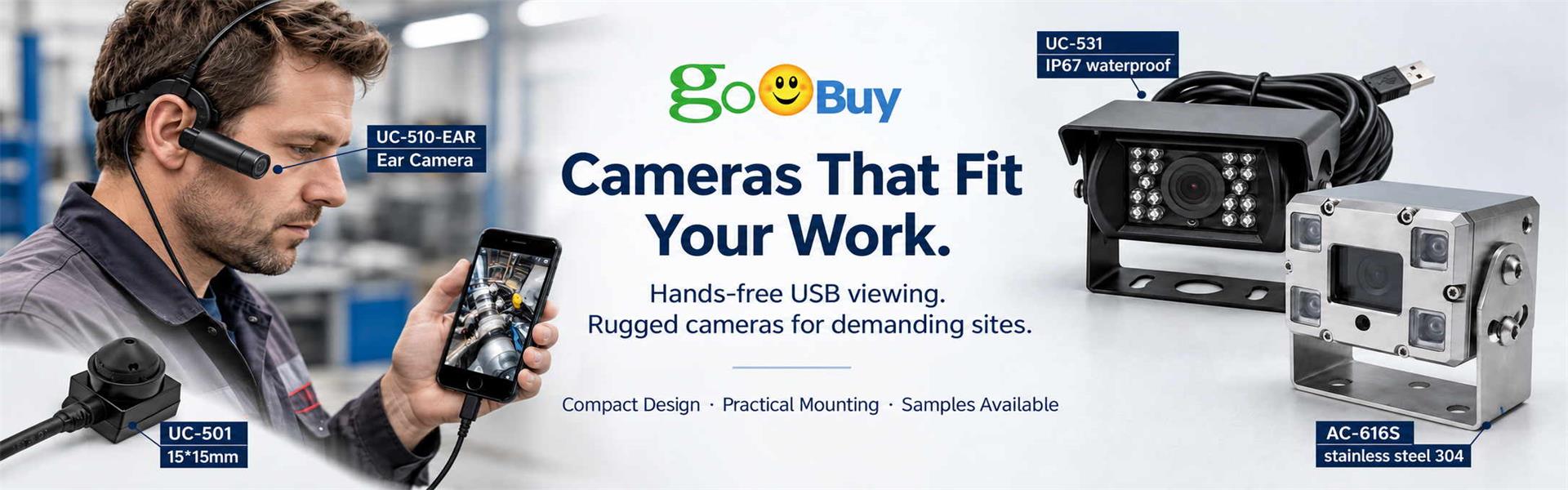
Special camera lenses are optical solutions for applications where a standard M12 lens cannot provide the required view because of limited installation space, a tiny viewing opening, low available light, ultra-wide coverage or changing target distance. Goobuy offers pinhole, F1.0 low-light, fisheye, zoom, endoscope and miniature lens families, with lens-only, lens-matching and complete camera options
When a standard camera lens cannot provide the required view, the problem may be the opening size, available light, viewing angle, target distance or installation space—not the camera resolution. Goobuy offers six special lens families for these situations, from 0.6mm-opening pinhole lenses and F1.0 low-light optics to 180°+ fisheye, zoom, endoscope and miniature lenses.
A conventional lens may be too visible or physically too large when the camera must look through a small hole in an enclosure, instrument or equipment panel.
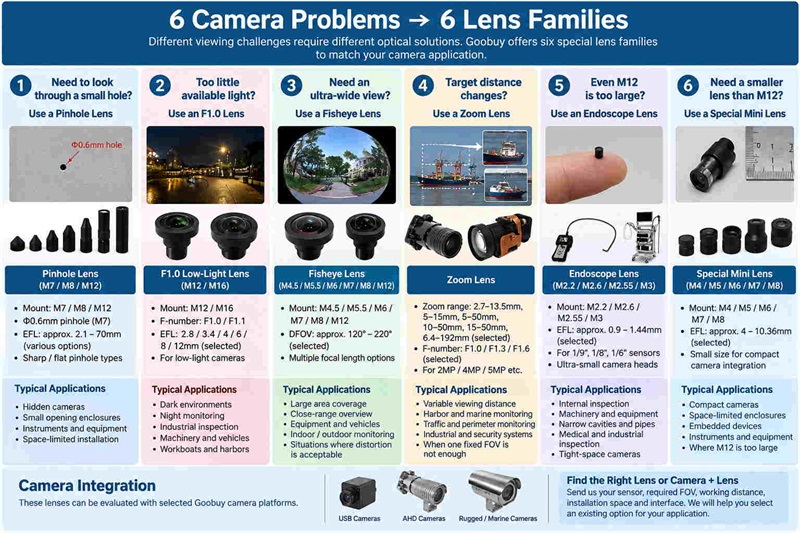
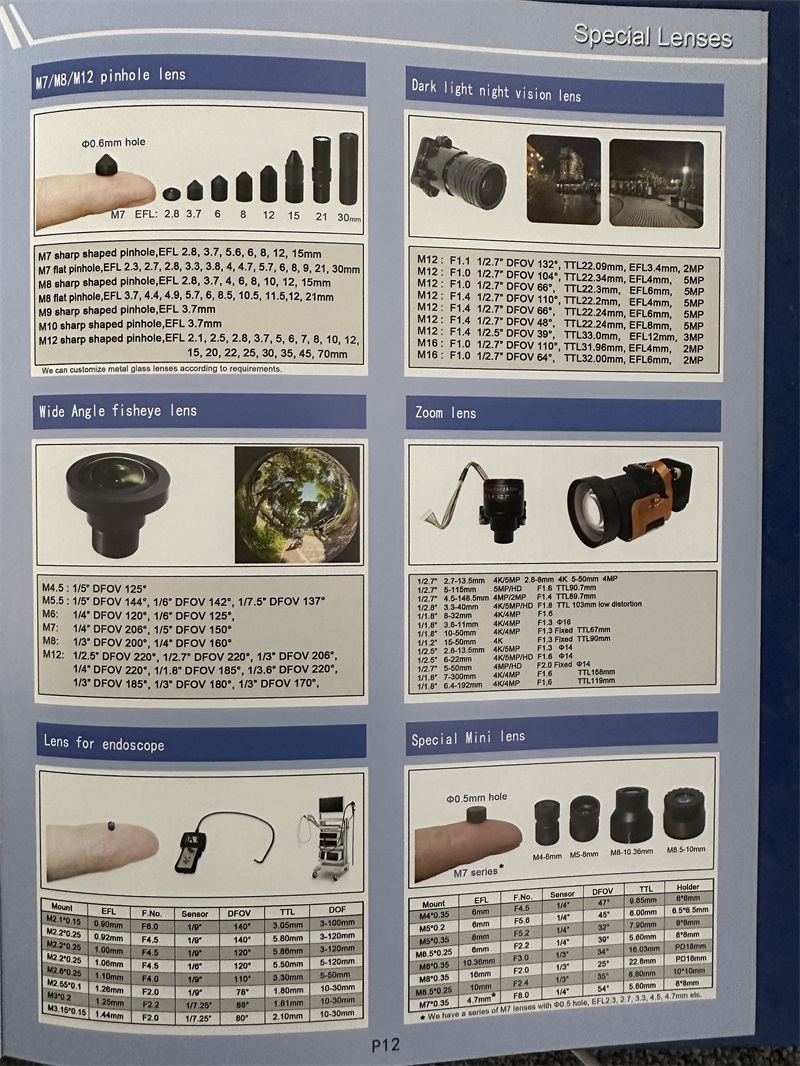
Goobuy's existing pinhole lens range includes:
M7 sharp pinhole lenses with a Φ0.6mm viewing hole and multiple focal lengths including 2.8, 3.7, 5.6, 6, 8, 12 and 15mm
M7 flat pinhole lenses with focal lengths extending from approximately 2.3mm to 30mm
M8 and M9 pinhole options
M12 sharp pinhole lenses covering multiple focal lengths from approximately 2.1mm to 70mm
This gives designers more choices than simply selecting a standard 2.8mm or 3.6mm M12 lens.
Best starting point when: the viewing opening or available mechanical space is the primary constraint.
When the scene is dim, increasing optical light collection may be more useful than simply increasing camera resolution.
Our low-light lens family includes M12 and M16 large-aperture options, including F1.0 configurations with focal lengths such as 2.8, 4, 6, 8 and 12mm depending on the lens.
These lenses can be evaluated for selected USB, AHD and other low-light camera platforms.
F1.0 does not create light or guarantee night vision. Sensor sensitivity, exposure, gain, illumination and ISP processing remain part of the complete low-light result.
Best starting point when: the existing camera has usable ambient light, but a conventional lens is limiting light collection.
Sometimes coverage is more important than maintaining a rectilinear image.
Goobuy offers fisheye and ultra-wide-angle lenses across M4.5, M5.5, M6, M7, M8 and M12 formats.
Depending on the specific lens and sensor combination, our catalog includes options with approximately 180°, 185°, 200°, 206° and up to 220° diagonal FOV directions.
These lenses can be useful for close-range overview cameras, compact equipment and applications where a conventional wide-angle lens still leaves important areas outside the image.
Strong fisheye distortion must be acceptable to the application.
Best starting point when: maximum nearby scene coverage matters more than geometric image correction.
A fixed lens is not always practical when the camera must observe targets at substantially different distances.
Our lens resources include multiple zoom ranges, including:
2.7–13.5mm
5–15mm
5–50mm
10–50mm
15–50mm
and selected longer telephoto configurations extending beyond these ranges.
Some configurations also offer relatively large apertures such as F1.0, F1.3 or F1.6.
The right zoom range should be selected from the sensor format, target size, working-distance range and required image detail—not from the maximum focal length alone.
Best starting point when: one fixed field of view cannot cover the required operating distances.
Very small inspection heads require a different optical architecture.
Goobuy's miniature endoscope lens resources include M2.2, M2.6, M2.55 and M3-class options, with focal lengths around 0.9–1.44mm in selected configurations.
For example, our catalog includes an M2.2×0.15, 0.9mm EFL lens for a 1/9-inch sensor with approximately 140° DFOV.
These lenses are intended for extremely compact visual access where a normal board-camera lens cannot physically fit.
They can also be evaluated with selected Goobuy tight-space USB inspection-camera platforms.
Best starting point when: camera-head diameter and access space are more important than using a conventional lens mount.
There is a useful middle ground between a standard M12 lens and an ultra-small endoscope optic.
Goobuy also has M4, M5, M6, M7 and M8 miniature lens options for compact camera integration.
These lenses can help when a camera must fit into a small enclosure while still meeting a defined FOV and working distance.
Best starting point when: M12 is mechanically too large, but the application does not require an extremely small endoscope camera head.
A request such as:
“I need a 4mm lens.”
is usually not enough to determine the right optic.
The same focal length can produce different fields of view on different sensors. The lens must also provide sufficient image-circle coverage, and wide-angle or fisheye designs introduce additional distortion considerations.
For a useful starting recommendation, we normally need:
Sensor model / sensor format
Required FOV or visible scene size
Working distance
Maximum lens or camera dimensions
Existing lens mount, if defined
Lighting conditions
For unusual installations, a photo or mechanical drawing is also useful.
Goobuy supports three practical starting points.
If you already know your camera and optical requirements, we can check our existing pinhole, low-light, fisheye, zoom, endoscope and miniature lens resources.
If you already have a camera board, send us the sensor model, lens mount, FOV, working distance and mechanical limits.
We can first evaluate whether an existing lens is close to the requirement.
If you also need the camera, selected lenses can be evaluated with existing Goobuy USB, AHD and other camera platforms.
This is particularly useful when the standard camera view does not fit the real installation.
You do not need to calculate the focal length before contacting us.
Tell us:
What sensor are you using?
What area must the camera see?
How far is the camera from the target?
How much installation space is available?
Do you need a lens only or a complete camera?
We will first check our existing lens and camera resources before discussing customization.
For an unusual camera application, start with the viewing problem. The right focal length should be the result of that requirement—not the first assumption.
Follow Me
Address:A615, 6F, Huachuangda Building, No107 Xinghua 1st Road, 43 District, Xinan street, Baoan, shenzhen, China 518101