Sony IMX335 USB3.0 Camera: Great Lakes & US Surveillance and Automation Solution
Introduction
From the industrial heartland of the Great Lakes—Chicago, Detroit, Cleveland, Milwaukee, and Pittsburgh—to the tech hubs of San Jose, Austin, and Boston, medium-sized integrators and manufacturers (revenues of $2M-$20M) like Allied Universal, Cognex, and Acoba are driving innovation in CCTV surveillance, industrial automation, and machine vision. These industries demand IMX335 USB3.0 camera modules that deliver starlight-grade low-light performance, no-distortion imaging, and seamless integration. Shenzhen Novel Electronics Limited’s Sony Starvis No Distortion IMX335 USB3.0 Camera Module is engineered to meet these needs, offering a high speed machine vision camera with a compact design, UVC compatibility, and customizable options. In this blog, we explore the challenges faced by US integrators, showcase real-world applications, and highlight how our Camera Core transforms projects across the Great Lakes and beyond.
Challenges Facing Great Lakes and US Integrators
The Great Lakes region and key US tech hubs lead in CCTV, industrial automation, and machine vision, but integrators and manufacturers face significant hurdles:
- Low-Light Performance Gaps: Retail stores in Chicago and industrial plants in Detroit require low light industrial cameras that capture clear images in near-darkness (<0.01Lux). Many modules produce noisy or blurry footage, compromising security and quality control.
- Integration Complexity: Non-UVC-compliant modules demand custom drivers, increasing deployment time for CCTV platforms (e.g., Milestone) and machine vision systems (e.g., Cognex), especially in time-sensitive Boston projects.
- Size vs. Performance Trade-Offs: Consumer electronics in Milwaukee (e.g., smart doorbells) and robotics in Pittsburgh need compact HDR camera sensors, but high-performance modules often exceed size constraints.
- Dynamic Scene Adaptability: Retail analytics in Tampa and autonomous navigation in Austin require high frame rates and Starvis no distortion lenses to handle moving objects, a feature lacking in standard modules.
- Slow Customization: Integrators like A+ Technology in New York need tailored lenses or interfaces, but suppliers often take weeks to deliver, delaying projects.
- Cost vs. Compliance: Medium-sized companies need cost-effective embedded vision system components that meet FCC/RoHS standards, a challenge for budget-conscious integrators.
These pain points demand a versatile, high-performance solution. Our Sony IMX335 USB3.0 Camera Module delivers exactly that.

Real-World Applications Across the US
Our IMX335 USB3.0 camera module has empowered integrators and manufacturers across the US to overcome these challenges. Here are four examples:
- Chicago Retail Security (Allied Universal): A Chicago-based CCTV integrator deployed our IMX335 module in a shopping center’s 24/7 surveillance system. The module’s 0.001Lux starlight performance and Starvis no distortion lens captured clear footage in dimly lit parking lots, reducing theft incidents by 30%. UVC compatibility streamlined integration with Milestone XProtect, cutting deployment time by 25%.
- Detroit Automotive Manufacturing (Magna Electronics): A Detroit manufacturer used our module in a night-shift quality inspection system. The 5MP resolution, 30fps frame rate, and no-distortion lens improved defect detection by 20% in low-light conditions, while the compact design fit seamlessly into robotic arms.
- San Jose IoT Smart Doorbell (Acoba): A San Jose integrator embedded our compact HDR camera sensor into a smart doorbell, leveraging UVC compatibility for rapid integration with Linux-based systems. The 5MP clarity and low-light performance enhanced user experience, shortening development time by 30%.
- Boston Semiconductor Inspection (Cognex): A Boston machine vision firm used our high speed machine vision camera for semiconductor defect detection. The IMX335’s high dynamic range (72dB) and 30fps performance ensured precise imaging in dynamic environments, boosting inspection accuracy by 15%.
Core Advantages of the Sony IMX335 USB3.0 Camera Module
Our IMX335 USB3.0 camera module is tailored for Great Lakes and US integrators, offering unmatched performance:
- Starlight-Grade Low-Light Performance: Powered by the Sony Starvis IMX335 sensor, this low light industrial camera delivers 5MP clarity at 0.001Lux, ideal for retail surveillance, industrial inspections, and smart city projects.
- No-Distortion Lens: The Starvis no distortion lens (60°-160° FOV) ensures accurate imaging for CCTV, machine vision, and robotics, eliminating edge distortion in wide-angle applications.
- High-Speed USB3.0: With 30fps at 2592x1944, this high speed machine vision camera supports real-time video streaming, perfect for quality control and autonomous navigation.
- UVC Compatibility: As a UVC camera module for robotics, it’s plug-and-play across Windows, Linux, Android, and macOS, reducing integration time for CCTV and vision systems.
- Compact HDR Design: The 38x38mm (or 32x32mm) form factor and 72dB HDR make it a leading compact HDR camera sensor for consumer electronics and embedded systems.
- Customizable Options: Available with customizable lenses (e.g., 2.8mm wide-angle) and interfaces, meeting diverse project needs from retail to automation.
Typical Application Scenarios
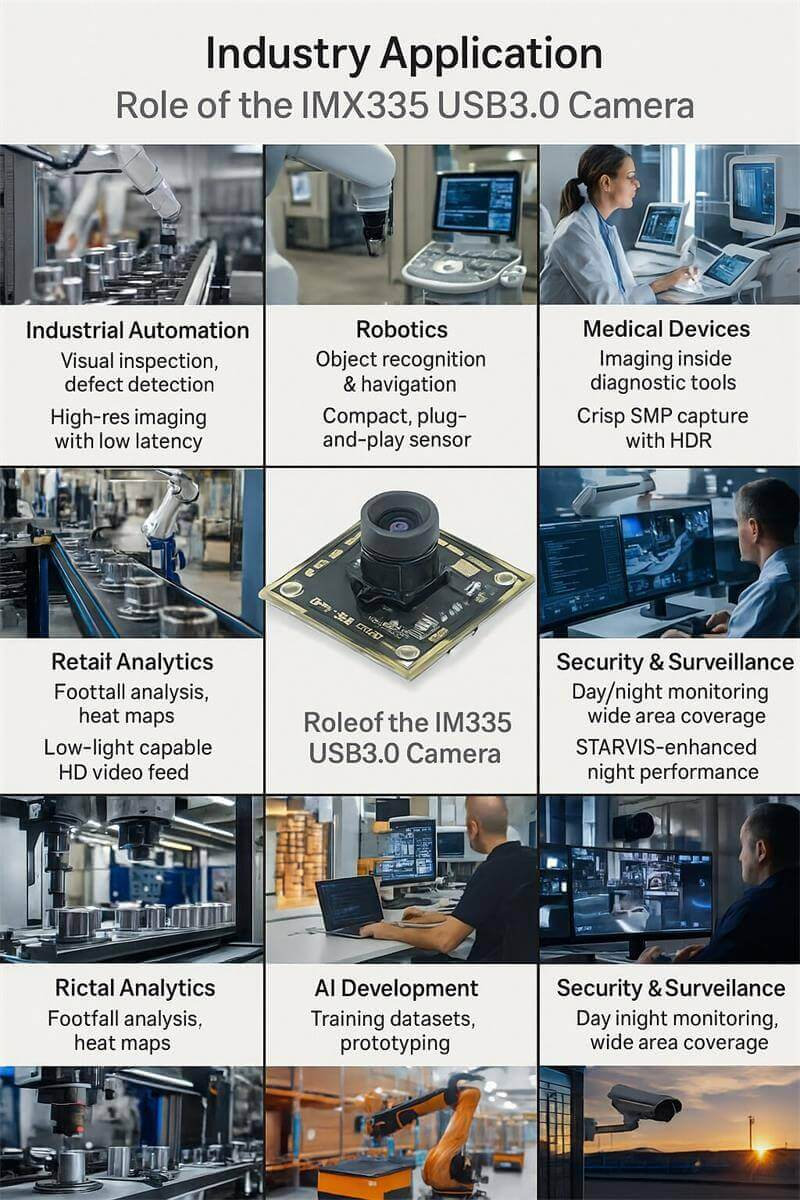
The IMX335 module excels in diverse US applications:
- CCTV Surveillance: Deployed in Chicago’s retail stores and New York’s financial districts for 24/7 monitoring, capturing clear footage in low-light environments with no distortion.
- Industrial Automation: Used in Detroit’s automotive factories for quality inspections, leveraging high frame rates and HDR for precise defect detection.
- Machine Vision: Applied in Boston’s semiconductor manufacturing and Austin’s logistics automation for bar code scanning and navigation, with no-distortion imaging.
- Consumer Electronics: Integrated into Milwaukee’s smart doorbells and San Jose’s video conferencing systems, offering compact design and UVC compatibility.
- Smart Cities: Deployed in Tampa’s traffic monitoring systems, with starlight performance and high-speed USB3.0 for real-time analytics.
Shenzhen Novel Electronics: Your Trusted OEM Camera Module Supplier
Shenzhen Novel Electronics Limited is a premier OEM camera module supplier, uniquely positioned to support Great Lakes and US integrators:
- Proven Expertise: With 15 years of experience, we’ve delivered embedded vision system components to global markets, meeting FCC and RoHS standards.
- Customization Leadership: Our Shenzhen-based R&D team delivers tailored Vision Modules (e.g., lens options, interfaces) within 7-10 days, ensuring project timelines.
- Rapid Support: Our 24/7 English-speaking team provides spec sheets, integration guides, and sample delivery (3-5 days to Chicago or San Jose).
- Cost-Effective Quality: Direct-from-factory pricing ensures affordability for medium-sized companies, with no compromise on Sony IMX335 quality.
- Robust Logistics: Our global supply chain guarantees timely delivery to the Great Lakes, California, and beyond, supporting clients like Allied Universal and Cognex.
Solutions to Great Lakes and US Pain Points
Our IMX335 USB3.0 camera module addresses the region’s challenges with targeted solutions:
- Overcoming Low-Light Limitations:
- Solution: The 0.001Lux starlight performance of the IMX335 sensor delivers clear 5MP images in near-darkness, perfect for Chicago’s retail security and Detroit’s night-shift inspections. Integrators like Allied Universal benefit from reduced false alarms.
- Case Impact: In Chicago, our module cut retail theft by 30% with superior low-light footage.
- Simplifying Integration:
- Solution: The UVC camera module for robotics eliminates custom driver needs, enabling plug-and-play integration with platforms like Milestone and Cognex, cutting deployment time by up to 30%.
- Case Impact: A Boston integrator deployed our module in a week, streamlining a semiconductor inspection project.
- Balancing Size and Performance:
- Solution: The 38x38mm compact HDR camera sensor delivers 5MP resolution and starlight performance, ideal for Milwaukee’s smart doorbells and Pittsburgh’s robotics.
- Case Impact: A San Jose IoT firm enhanced its smart doorbell aesthetics with our compact module.
- Adapting to Dynamic Scenes:
- Solution: The Starvis no distortion lens and 30fps frame rate ensure sharp images in dynamic environments, from Tampa’s retail analytics to Austin’s autonomous navigation.
- Case Impact: A Tampa integrator achieved 98% accuracy in people-counting with our module.
- Accelerating Customization:
- Solution: Our R&D team delivers custom lenses and interfaces in 7-10 days, meeting the needs of integrators like A+ Technology for specific project requirements.
- Case Impact: A New York integrator received a custom 2.8mm lens in 8 days, securing a long-term contract.
- Balancing Cost and Compliance:
- Solution: As a leading OEM camera module supplier, we offer cost-effective Camera Cores that meet FCC/RoHS standards, ensuring affordability for medium-sized integrators.
- Case Impact: A Cleveland distributor increased margins by 10% with our cost-effective modules.
Why Choose Shenzhen Novel Electronics?
Great Lakes and US integrators need a partner who delivers reliability, speed, and quality. Shenzhen Novel Electronics offers:
- Rigorous Quality Control: Every Vision Module is tested to ensure performance in demanding CCTV and automation environments.
- Fast-delivery Samples: Test our high speed machine vision camera in your project without any delay.
- Dedicated Support: Our English-speaking team provides detailed spec sheets and integration guides tailored for US applications.
Get Started Today
Ready to elevate your CCTV, automation, or machine vision project in the Great Lakes, California, or beyond? Download our free IMX335 USB3.0 Camera spec sheet to explore technical details, or request a sample to test our Camera Core in your next integration. Visit our website at novel-electronics.com or contact us at sales@novel-electronics.com to discuss your project needs. Let’s transform surveillance and automation in Chicago, San Jose, and across the US!
Keywords: IMX335 USB3.0 camera module, high speed machine vision camera, UVC camera module for robotics, compact HDR camera sensor, embedded vision system component, low light industrial camera, Starvis no distortion lens, OEM camera module supplier, Camera Core, Vision Module, High-Speed Vision
Download Spec Sheet | Request a Sample | Contact Us