
A USB thermal camera module is an embedded infrared imaging component used by OEM engineers to add temperature-aware vision to edge AI devices, industrial inspection systems, robotics, energy equipment, mining monitoring, cold-chain systems and predictive maintenance platforms. The right module is selected by resolution, NETD sensitivity, lens FOV, module size, interface, host compatibility, working distance and whether the system needs visual detection, hot-spot monitoring or AI thermal analysis.
Introduction
Selecting the right thermal imaging module for your application requires a clear understanding of resolution, module size, and interface options, each impacting performance and suitability across industries like industrial monitoring, consumer electronics, robotics, and hunting. At Shenzhen Novel Electronics Limited, our micro thermal imaging modules (resolutions: 256x192, 384x288, 640x512, 1280x1024; sizes: 21x21mm, 25x25mm, 28x28mm; interfaces: USB2.0, USB-C, CVBS) offer versatile solutions tailored to diverse needs. This blog compares these specifications, highlighting their performance advantages, differences, and ideal use cases for engineers and product managers in North America and Europe.
Who This Guide Is For
This guide is written for OEM product managers, embedded system engineers, industrial equipment builders, robotics teams, energy monitoring integrators, mining technology companies, cold-chain equipment developers, electronics inspection teams and edge AI hardware companies that need to select a thermal imaging module for a real product.
It is not mainly written for hobby users, consumer thermal accessories or low-cost hunting camera buyers. If you are developing an industrial device, edge AI system, inspection tool, smart equipment platform or embedded thermal monitoring product, the key question is not only “Which thermal resolution is higher?” but “Which module can match the target object, working distance, host system, interface, installation space and environmental conditions?”
Resolution Selection Guide: Choose 256x192 for cost-sensitive consumer or hunting applications, 384x288 for mid-range industrial and robotics tasks, 640x512 for high-detail industrial and military needs, and 1280x1024 for premium, mission-critical applications.
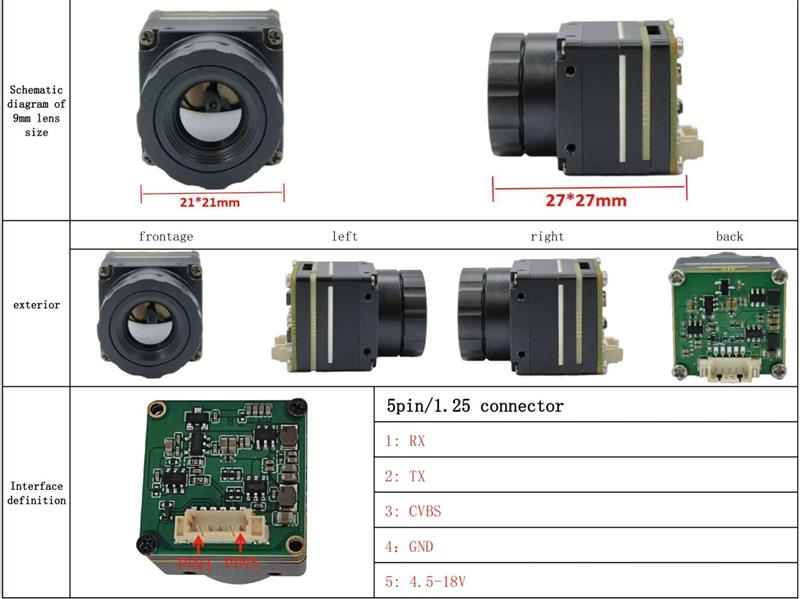
Size Selection Guide: Select 21x21mm for drones and wearables, 25x25mm for balanced industrial and robotics applications, and 28x28mm for high-performance, fixed installations.
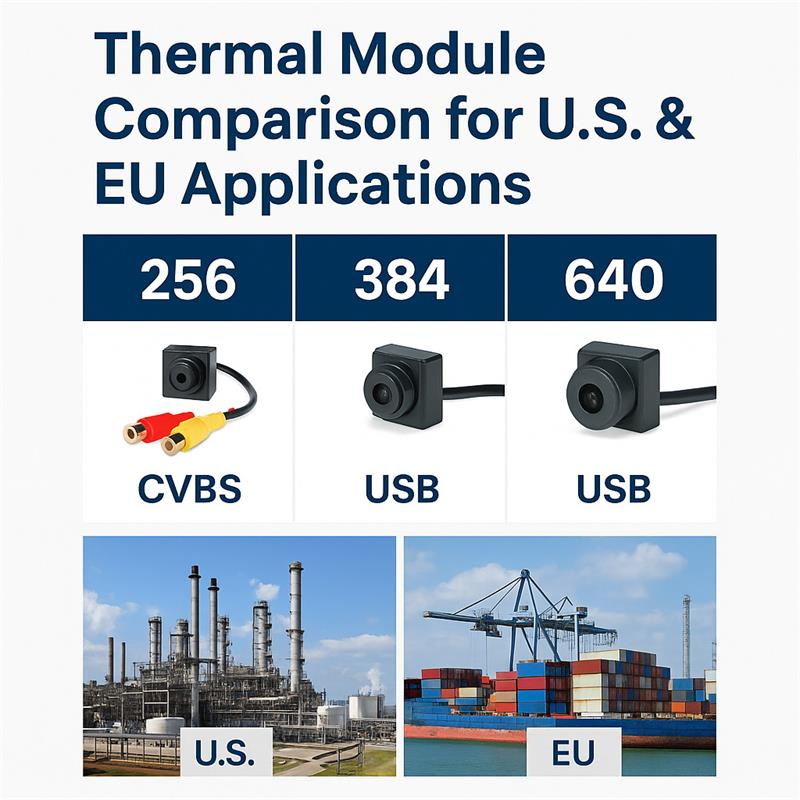
Interface Selection Guide: Choose USB2.0 for cost-effective, legacy-compatible applications, USB-C for modern, high-resolution systems, and CVBS for analog-based industrial or security setups.
2026-2027 High-Value Use Cases for USB Thermal Camera Modules
Thermal camera modules are no longer used only for handheld inspection tools. In 2026, more OEM teams are evaluating embedded thermal imaging for edge AI devices, industrial equipment monitoring, robotics, energy infrastructure, mining systems, cold-chain equipment and electronics inspection benches. The following use cases are more relevant for professional B2B projects than generic consumer thermal applications.
Industrial Predictive Maintenance and Hot-Spot Monitoring
For motors, bearings, pumps, switchgear, electrical cabinets, conveyors and factory equipment, thermal modules can be used as continuous visual sensors rather than occasional handheld inspection tools.
A 384×288 or 640×512 USB thermal camera module can be evaluated for hot-spot monitoring, abnormal heat detection, equipment temperature trend observation and edge AI predictive maintenance systems.
Typical search and project terms include: USB thermal camera for predictive maintenance, hot-spot detection camera module, thermal camera for motors and bearings, thermal imaging module for electrical cabinets, and edge AI thermal inspection.
Energy, Power and Utility Infrastructure Monitoring
Energy infrastructure often needs thermal monitoring for substations, battery storage systems, power cabinets, solar panels, pipelines and remote equipment rooms.
For these applications, long-term stability, interface reliability, lens selection, enclosure design and host compatibility may be more important than choosing the highest resolution only.
Typical search and project terms include: thermal camera module for energy monitoring, substation thermal inspection, battery storage thermal camera, solar farm thermal inspection, power cabinet thermal monitoring and pipeline thermal monitoring.
Mining and Heavy Industrial Equipment
In mining, cement, steel and heavy industrial sites, thermal camera modules can help monitor conveyor rollers, bearings, motors, crushers, electrical cabinets, hydraulic systems and fire-risk zones.
A visible camera shows the scene. A thermal camera shows the heat problem. Some OEM systems may need a visible + thermal design to provide both visual context and temperature awareness.
Typical search and project terms include: thermal camera module for mining, conveyor roller hot-spot detection, thermal imaging for crushers and motors, mining equipment thermal monitoring and visible and thermal camera module.
Robotics and Edge AI Sensor Fusion
Robots and edge AI devices may use thermal imaging when visible cameras cannot answer the full question. Inspection robots, warehouse safety systems, industrial edge boxes and autonomous devices may need thermal input for heat-risk monitoring, poor-visibility detection or visible + thermal sensor fusion.
For these projects, the thermal module should be selected together with the visible camera, host platform, AI pipeline, working distance, FOV and interface.
Typical search and project terms include: thermal camera module for robots, USB thermal camera for edge AI, thermal vision for inspection robot, visible thermal sensor fusion, Jetson thermal camera module and RK3588 thermal camera module.
Cold Chain, Refrigeration and Smart Equipment
Cold-chain systems, smart freezers, refrigerated cabinets and industrial refrigeration equipment can use thermal imaging to observe temperature distribution, heat leakage, frost patterns, compressor area heat, abnormal cabinet conditions or equipment thermal imbalance.
For these systems, compact module size, USB interface, low power, enclosure design and integration with the host controller are important selection factors.
Typical search and project terms include: thermal camera for cold chain monitoring, thermal imaging for refrigeration equipment, freezer thermal monitoring module, cold storage thermal camera and thermal module for smart freezer equipment.
Thermal Module Selection by Real Problem
| Customer Problem | Recommended Direction |
| Need low-cost temperature awareness | 256×192 USB thermal module |
| Need balanced industrial hot-spot detection | 384×288 USB / USB-C thermal module |
| Need high-detail equipment or PCB thermal analysis | 640×512 thermal module |
| Need premium long-distance or mission-critical thermal detail | 1280×1024 thermal module |
| Need compact edge device integration | 21×21mm / 25×25mm micro thermal module |
| Need high-resolution fixed installation | 28×28mm or larger thermal module |
| Existing analog monitor or DVR system | CVBS thermal output |
| Linux / Windows / edge AI host | USB2.0 or USB-C thermal output |
| Need AI thermal analysis | USB-C / high-resolution module with host-side processing |
| Need visible context + heat information | Visible + thermal camera module discussion |
| Need field deployment in harsh environments | Thermal module + custom housing / lens / cable design |
Not the Best Fit If You Need
Goobuy thermal camera modules may not be the best fit if you need a finished consumer thermal camera, a certified medical diagnostic device, a weapon sight, a complete AI analytics software platform, or a fully certified defense / security system.
Goobuy is best suited for OEMs, system integrators and hardware teams that already have a host device and need a compact thermal imaging module, USB thermal sensor, CVBS thermal output, visible + thermal design, or customized embedded thermal camera solution for a real product.
Tell Us What Your Thermal System Needs to Detect
A thermal module should not be selected by resolution alone. The right choice depends on the target object, working distance, temperature range, lens FOV, module size, interface, host system, environmental condition and whether the system needs simple visual temperature awareness, industrial hot-spot monitoring, edge AI thermal analysis or visible + thermal sensor fusion.
Please send your target object, working distance, expected temperature range, required FOV, installation space, host platform, interface requirement, environment condition, sample quantity and expected production volume.
Goobuy can help evaluate whether your project should start with a 256×192, 384×288, 640×512 or 1280×1024 thermal module, USB2.0, USB-C, CVBS output, compact 21×21mm design, high-resolution 28×28mm design, or a customized visible + thermal camera solution.
For OEM thermal imaging projects, email us your requirement and application background. A short engineering description is more useful than only asking for a resolution or sensor model.
This Article blog is updated in the morning of May 13th, 2026 by NOVEL
Follow Me
Address:A615, 6F, Huachuangda Building, No107 Xinghua 1st Road, 43 District, Xinan street, Baoan, shenzhen, China 518101