
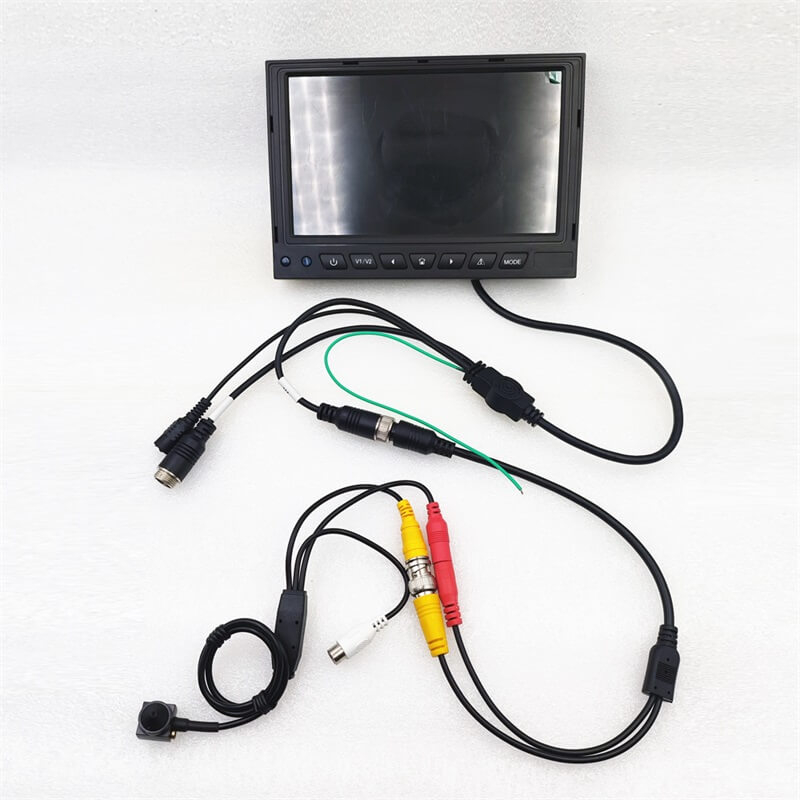
Goobuy AC-607 is a micro AHD camera DVR kit used when engineers need a small camera near a hidden machine problem, a stable analog-HD cable path, and a local monitor with recording for extreme equipment monitoring. In mining, conveyors, BESS service cabinets, substations, heavy industry, energy facilities, wastewater plants and environmental monitoring sites, this kit helps maintenance teams see and record what happens inside protected machines, cabinets, transfer points, service panels and compact equipment spaces without using IP camera setup, USB host software, cloud video or a laptop-based inspection workflow.
Goobuy AC-607 is a micro AHD camera DVR kit used when engineers need a small camera near a hidden machine problem, a stable analog-HD cable path, and a local monitor with recording for extreme equipment monitoring.
In many industrial sites, the equipment is already running under difficult conditions. The machine may be dusty, wet, enclosed, vibrating, remote, hot, cold, difficult to access or installed inside a protected cabinet. The maintenance team may not need a cloud camera or AI platform. They may need something more direct:
a compact camera near the problem,
a cable path back to a local monitor,
and recorded video evidence showing what actually happened.
This is the real value of a micro AHD camera DVR kit.
It is not a general CCTV camera.
It is not a smart IP surveillance system.
It is not an AI vision computer.
It is a practical local visual evidence tool for equipment maintenance, machine debugging and protected harsh-site monitoring.
The Goobuy AC-607 direction combines a compact AHD camera with a local DVR monitor.
A typical configuration may include:
The kit is designed for situations where the camera must be placed near a hidden equipment point, while the operator or technician watches and records video from a more convenient location.
Recommended product direction:
Industrial AHD Camera DVR Kit for Harsh-Site Equipment Monitoring
Suggested internal link:
/ODM-industrial-AHD-camera-system.html
Extreme equipment does not always need a smarter camera.
It often needs a camera that can answer simple but critical questions:
For maintenance teams, these questions can be more valuable than a high-end camera specification.
AC-607 provides a simple visual evidence path:
micro AHD camera near the fault point → cable to DVR monitor → local viewing and recording → maintenance review
That workflow is the reason this product matters.
Many equipment faults happen in places people cannot easily see.
Examples include:
A normal camera may be too large.
A mobile phone may not fit.
A laptop-based USB camera may be inconvenient.
An IP camera may require network setup.
A standard CCTV camera may not see the hidden point.
A micro AHD camera can be installed closer to the real problem area, while the DVR monitor stays outside the machine or cabinet.
This gives maintenance teams a direct visual window into the equipment.
In many industrial environments, adding an IP camera is not simple.
The customer may not allow a new network device.
The equipment may not have Ethernet access.
The site may have cybersecurity restrictions.
The maintenance team may not want cloud video.
The operator may only need temporary local viewing.
The technician may need evidence immediately, not after software configuration.
AC-607 solves this by using a local AHD camera-to-monitor workflow.
The technician can view and record the equipment behavior locally without configuring an IP address, installing camera software, logging into a cloud account or bringing a laptop into the field.
This is especially useful for:
Space-limited equipment often has awkward cable paths.
The cable may need to pass through:
USB is useful when a host is nearby, but it is not always convenient for long camera-to-monitor runs.
AHD is often more practical when the camera must be installed near the hidden target and the monitor is located several meters away in a service area, operator panel or maintenance station.
The correct cable design still matters. Engineers should confirm:
AC-607 is not just a camera. It is a camera + cable + monitor recording workflow.
Some equipment faults only appear while the machine is operating.
Examples:
The maintenance team cannot always stop the machine, remove covers and inspect manually.
A local AHD DVR kit allows technicians to observe the machine behavior during operation from a safer or more convenient position, then replay the video after the event.
This is the actual value: not only seeing, but proving.
The AC-607 micro AHD DVR kit can support extreme equipment monitoring, but the camera structure must match the installation.
It is suitable for:
It may not be suitable by itself for direct exposure to:
For directly exposed harsh environments, the project may need waterproof AHD cameras, IP69K camera heads, stainless housings, sealed cables, rugged connectors or certified camera equipment.
This distinction should be clear:
AC-607 is strongest as a protected local visual evidence kit, not as a universal exposed rugged camera.
Conveyors are one of the best applications for a micro AHD DVR kit because many conveyor problems are visual and intermittent.
Typical problems include:
AC-607 can place a small camera near the transfer area or inside a protected conveyor box, while the DVR monitor stays near the operator station or service panel.
The recorded video can help engineers answer:
For conveyor roller, bearing or motor overheating, thermal cameras may still be required. AHD visible video shows the scene; it does not measure temperature.
Mining equipment often operates in dust, vibration, low light and remote maintenance conditions.
AC-607 can support protected mining-related applications such as:
The camera should normally be installed inside a protected enclosure, viewing window or service structure.
If the camera is directly exposed to open mining dust, vibration, mud, water or impact, a rugged or sealed camera structure should be considered instead.
Best role in mining:
local visual evidence for protected equipment points where operators need to see what happened without adding an IP camera system.
BESS systems require BMS data, thermal monitoring, fire-safety systems and site-specific safety design. AHD video does not replace those layers.
However, AC-607 can add visible evidence around protected service points.
Possible uses include:
Correct BESS role:
BMS and sensors detect system status. Thermal devices detect heat risk. AC-607 records visible maintenance context and equipment behavior.
This makes the kit useful for service workflows, not for thermal safety detection.
Substations and utility power equipment may require visual inspection around protected panels, cabinets, relay rooms, service areas and local equipment stations.
AC-607 can help with:
For utility use, the final system must consider:
The camera kit provides visual evidence. It does not replace electrical system design or utility-grade site validation.
Heavy industry includes steel, cement, recycling, manufacturing, chemical processing, ports, machinery and large process equipment.
AC-607 can help engineers see and record:
This is different from general surveillance.
The camera is not watching people or buildings.
It is watching a specific machine problem.
That makes the video much more useful for engineering teams.
Energy facilities often include pump stations, compressor stations, generator rooms, solar service cabinets, wind equipment terminals, field shelters and remote infrastructure.
AC-607 can support:
If the area is hazardous, certified camera hardware may be required. A standard AHD kit should not be assumed suitable for ATEX, IECEx or other hazardous-zone requirements.
If the camera must be directly exposed outdoors, sealed or waterproof camera hardware may be needed.
Wastewater and environmental monitoring sites often contain pump rooms, wet cabinets, treatment equipment, control panels and remote sensor stations.
AC-607 can be useful for:
Moisture and corrosion are real issues. The selected camera, cable and enclosure must match the actual exposure.
For wet or washdown positions, IP69K AHD or waterproof camera hardware may be a better direction.
Machine builders often need a repeatable way to see inside their own equipment during testing, commissioning or customer service.
AC-607 can become part of:
This use case can be commercially valuable because the kit is not only used once. It can become a repeated service tool for the machine builder’s installed base.

Best-fit applications include conveyor troubleshooting, wastewater pump stations, BESS service cabinets, utility equipment panels, recycling systems, heavy machinery, field service kits and industrial machine fault recording.
Best-fit applications include mining conveyors, remote equipment shelters, pump station service work, cold-region utility cabinets, heavy machinery maintenance and field-service visual evidence.
Best-fit applications include machine builder test fixtures, production equipment troubleshooting, automation cabinets, service panels, commissioning tools and industrial maintenance workflows.
Best-fit applications include conveyors, bulk material handling, factory equipment, logistics machinery, machine service panels and local DVR maintenance systems.
Best-fit applications include mining service areas, tunnel equipment, forestry machinery, protected utility devices and compact field-service tools.
Best-fit applications include offshore support equipment cabinets, port machinery service tools, wastewater utilities, marine-adjacent maintenance stations and protected energy equipment.
Best-fit applications include BESS service points, water infrastructure, solar service cabinets, machine interiors, tunnel maintenance devices and environmental monitoring equipment.
Across these markets, the strongest fit is the same:
extreme equipment + hidden visual problem + protected camera position + local DVR evidence.
Choose AC-607 when:
Choose IP camera when:
AC-607 is not a replacement for all IP cameras. It solves a different problem.
Choose AC-607 AHD DVR kit when:
Choose USB camera when:
AHD is better for local visual evidence.
USB is better for software-side video.
Choose AC-607 15×15mm direction when:
Choose 6×6mm AHD direction when:
Related direction:
6×6mm Micro AHD Camera Monitor Kit
Suggested internal link:
/6mm-1080P-AHD-camera-system.html
Choose AC-607 when:
Choose IP69K AHD camera when:
Related direction:
IP69K AHD Camera Kit for Harsh Industrial Equipment
Suggested internal link:
/industrial-waterproof-camera-system.html
AC-607 should not be over-positioned.
It does not solve:
It solves the local visible evidence problem.
That is already valuable when the maintenance team needs to see what really happened.
| Equipment Situation | AC-607 Value |
|---|---|
| Hidden machine fault | Places a small camera near the problem |
| Conveyor transfer issue | Records material flow and blockage behavior |
| Cabinet service problem | Provides local visual evidence |
| BESS maintenance point | Records visible service context |
| Substation panel check | Supports protected local viewing |
| Pump station troubleshooting | Documents equipment behavior |
| Machine commissioning | Captures repeatable video proof |
| Field service visit | Records before-and-after evidence |
| Customer dispute | Provides visual event replay |
| Training and maintenance review | Creates recorded examples from real equipment |
| No IP network allowed | Uses local AHD monitor workflow |
| No software host available | Avoids USB / laptop dependency |
| Direct wet exposure | Use IP69K or waterproof camera instead |
| Heat detection required | Use thermal camera instead |
Before requesting a sample, prepare:
This information helps confirm whether AC-607 is suitable or whether USB, IP69K AHD, 6×6mm AHD, thermal or another camera system should be evaluated.
Goobuy AC-607 micro AHD camera DVR kit has major practical value in extreme equipment monitoring because it gives maintenance teams a direct way to see and record hidden machine behavior.
Its value is not in being a smart surveillance camera.
Its value is in local visual evidence.
For conveyors, it can record transfer-point faults.
For mining equipment, it can help view protected service areas.
For BESS cabinets, it can document visible maintenance context.
For substations, it can support protected panel observation.
For heavy industry, it can record hidden machine behavior.
For pump stations and energy facilities, it can support local troubleshooting.
For wastewater and environmental monitoring sites, it can document protected equipment conditions.
For machine builders, it can become a repeatable debugging and service tool.
Use AC-607 when the project needs:
a small camera near the equipment problem, analog-HD cable routing, local monitor display and DVR recording without IP setup, USB host software or cloud video.
Use a different camera architecture when the project needs thermal detection, AI processing, IP network monitoring, direct IP69K exposure, high-speed inspection or certified hazardous-zone equipment.
If your machine or equipment runs in an extreme environment and your maintenance team needs local visual proof of what happened, send Goobuy your equipment type, camera position, working distance, cable length, monitor requirement, environmental risk and sample plan.
Goobuy can help evaluate whether AC-607 is the right starting point for your local visual evidence workflow.
Goobuy AC-607 is used for local real-time viewing and DVR recording in equipment maintenance, machine debugging, conveyor troubleshooting, protected cabinets, service panels, inspection hatches and compact harsh-site equipment spaces where a small camera must be placed near a hidden problem.
It is useful because many extreme-equipment faults happen inside machines, cabinets or covered structures. A micro AHD camera can be placed near the problem, while the DVR monitor stays in a safer or more convenient position for live viewing, recording and replay.
Yes. AC-607 can be used for protected mining equipment, conveyor transfer boxes, service panels and maintenance stations. If the camera is directly exposed to dust, mud, vibration, water or impact, a rugged or waterproof camera structure should be evaluated.
Yes, it can support protected BESS service cabinets, utility panels, substation equipment rooms and maintenance workflows where visible evidence is needed. It does not replace BMS, thermal cameras, fire-safety systems, electrical sensors or utility-grade protection design.
AC-607 is better when the task is local display and DVR evidence without IP setup or network integration. IP cameras are better for remote network monitoring, VMS integration, PoE systems and multi-camera site management.
AC-607 is better when the technician needs local monitor display and DVR recording without a PC host. USB cameras are better when the video must go into Linux, Windows, Android, Jetson, Raspberry Pi, OpenCV or AI software.
No. AC-607 provides visible video. It does not measure temperature. For conveyor bearing overheating, BESS thermal abnormality, electrical hotspots or fire-risk monitoring, thermal cameras or temperature sensors should be evaluated.
Please send the equipment type, camera position, protected or exposed installation, monitor size, cable length, connector type, working distance, field of view, lighting condition, environmental risks, recording need, sample quantity and pilot schedule.
www.okgoobuy.com/ODM-industrial-AHD-camera-system.html
this article is updated by Mr Art huang from shenzhen novel electronics limited in July 19th, 2026
Follow Me
Address:A615, 6F, Huachuangda Building, No107 Xinghua 1st Road, 43 District, Xinan street, Baoan, shenzhen, China 518101