

Technical Overview for Field Engineers
AHD DVR inspection systems are designed for environments where real-time video, long cable distance, and deployment simplicity are critical. Unlike USB or IP camera setups, standalone AHD systems eliminate driver installation, network configuration, and computer dependency.
These systems are commonly used in industrial maintenance, equipment inspection, and confined-space diagnostics where reliability, low latency, and portability matter more than advanced software features.
Engineers typically select AHD solutions when real-time response, electrical interference resistance, and rapid deployment are higher priorities than network streaming or cloud connectivity.
Executive Summary: Why AHD Survives in 2026
The Problem: WiFi borescopes suffer from 500ms+ latency and signal loss underground or inside metal ducts.
The Solution: Wired AHD (Analog High Definition) technology provides instant, uncompressed video transmission over coaxial cables up to 500 meters.
The Upgrade: Modern AHD DVR kits now feature 1000-nit IPS screens for outdoor visibility, USB-C fast charging, and 256GB storage for "Before & After" client reports.
In the fast-paced world of industrial equipment maintenance and repair, efficiency, portability, and reliable visual inspection are critical. Field technicians and service engineers face a daily challenge: they must diagnose and repair complex machinery often located in confined spaces, harsh environments, or remote sites — all while ensuring minimal downtime and safety.
Traditional inspection setups usually rely on bulky cameras connected to laptops or stationary monitors, which are cumbersome and slow to deploy. That’s why micro AHD (Analog High Definition) camera modules paired with rugged 7-inch DVR displays are rapidly becoming the go-to solution for field maintenance teams across the United States and worldwide.
"What You See Is What You Touch" (Zero Latency)
In field maintenance, timing is everything. When you are pushing a specialized camera probe 30 meters down a clogged drain, a 2-second WiFi delay means you might push past the crack or damage your expensive tool.
AHD technology delivers Zero Latency. The video on your screen is perfectly synchronized with your hand movements. This "Real-Time Feedback" is critical for:
Robotic Crawlers: Navigating tight turns in HVAC ducts.
Fishing/Salvage: Hooking objects underwater where visibility is poor.
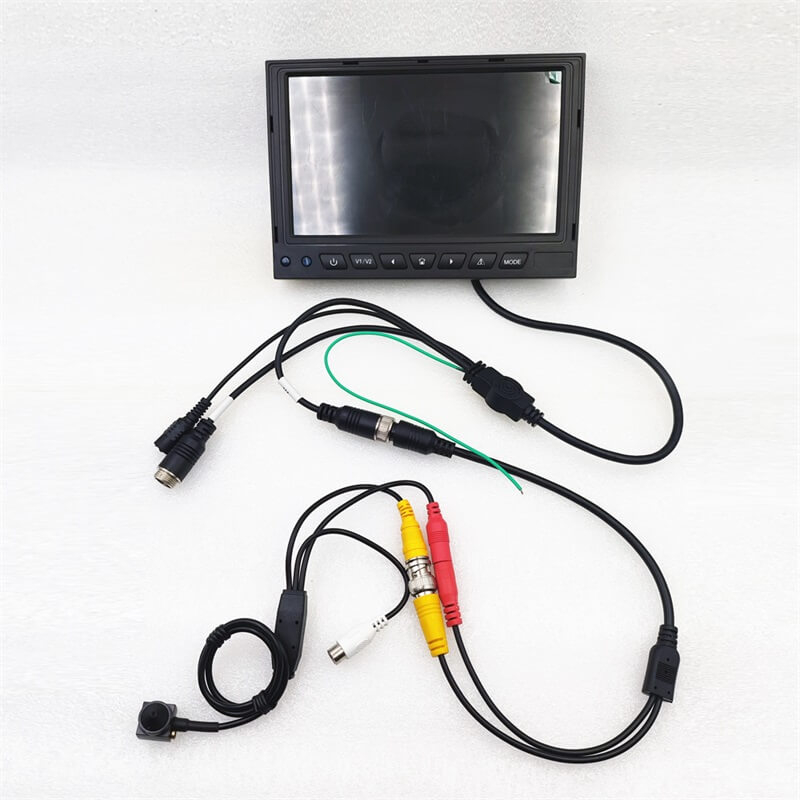
At the heart of these solutions is a 2MP micro AHD camera module measuring just 15×15mm. This tiny camera is small enough to be inserted into hard-to-reach areas of industrial equipment — gearboxes, pipelines, valve assemblies, and more — without disassembly or disruption.
Despite its compact size, it delivers crisp 1080p video with wide-angle lens options (90° to 110°), enabling technicians to get detailed, high-resolution views of internal components.
Unlike USB or IP cameras, AHD technology transmits video signals over coaxial cables with near-zero latency, allowing technicians to see live images instantly on the attached 7-inch DVR display. This real-time feedback is crucial when performing precision inspections or aligning components.
Latency Clarification for Practical Use
In analog AHD systems, transmission delay is minimal because video is delivered directly from sensor to display without encoding or network processing. Actual perceived latency mainly depends on monitor processing time and recording buffer behavior, which are typically negligible for inspection tasks.
This characteristic makes AHD systems particularly suitable for alignment work, live diagnostics, and mechanical positioning operations.
The 7-inch HD display with built-in DVR functionality is housed in a durable, waterproof (IP65) case, built to withstand dusty, oily, or outdoor environments typical in factories, refineries, and construction sites.
Powered by 12V DC input, the display supports portable power sources such as batteries or vehicle power systems, making it ideal for remote or mobile field operations.
The AHD camera connects directly to the DVR monitor via standard coaxial cable, requiring no drivers, software, or complicated network setup. The plug-and-play design means field engineers can quickly set up, start inspections, and record video footage for documentation and analysis.
Typical Field Inspection Workflow
Field technicians usually follow a simple three-step process:
Setup — connect camera, power source, and display
Inspect — visually examine components in real time
Record — capture footage for reporting, analysis, or documentation
This workflow reduces preparation time and eliminates the need for laptops or software configuration, allowing maintenance teams to focus on diagnostics rather than setup.
Maintenance crews can insert the micro AHD camera into inspection ports or crevices to detect wear, corrosion, oil leaks, or alignment issues without disassembling machinery — saving valuable time and reducing the risk of additional damage.
The system helps technicians visually inspect internal surfaces of pipelines, tanks, and vessels where human entry is impossible or dangerous, enabling proactive maintenance and early detection of problems.
For environments with hazardous gases or extreme temperatures, technicians can use the portable kit to conduct inspections safely from outside the danger zone, reducing exposure risks.
The DVR feature allows recording inspection sessions, which can be used later for training new technicians or creating maintenance reports to ensure compliance with safety and quality standards.
2025-2026 Retrofitting & DIY Inspection Rigs
1. The DIY Sewer Camera (USA & Europe) Professional inspection systems (like Ridgid or Rothenberger) cost thousands. When their monitors die, smart technicians don't buy new. They retrofit. By combining a goobuy AHD Camera Head (IP68 Stainless Steel) with our 7-inch DVR Monitor, you can build or repair a pipe inspection system for 1/10th the cost of a brand-name unit.
2. Rooftop HVAC Inspection (High Brightness) For technicians working on commercial rooftops in California or Texas, standard screens wash out in the sun. Our 2026 kits feature 1000-nit High-Brightness IPS Panels, allowing you to review flue conditions clearly without needing a bulky sunshade.
Industry Trend: Simplified Field Toolkits
Maintenance teams increasingly prefer standalone diagnostic tools that require minimal setup and no external computing devices. In many industrial environments, connecting laptops or accessing networks is restricted due to safety, security, or practicality concerns.
As a result, self-contained inspection systems that operate independently of PCs or network infrastructure are becoming standard equipment for field service technicians.

|
Component |
Specification |
|
Camera Resolution |
2 Megapixels (1920×1080) |
|
Camera Dimensions |
15×15mm PCB module |
|
Lens Options |
90°, 110° wide-angle available |
|
Low Light Sensitivity |
≥0.01 Lux |
|
Signal Type |
Analog High Definition (AHD) |
|
Display Size |
7 inches |
|
Display Resolution |
1024×600 pixels |
|
DVR Recording |
Built-in SD card slot, supports video record |
|
Waterproof Rating |
IP65 (Display) / Optional IP67 (Camera housing) |
|
Power Input |
12V DC, supports portable power solutions |
|
Connectivity |
Coaxial cable (up to 100 meters) |
Specification Interpretation Notes
Cable transmission distance up to 100 meters makes AHD systems suitable for large equipment, factory floors, and multi-room inspection scenarios.
Low-light sensitivity around 0.01 lux enables operation in dim environments, though extremely dark conditions may still require supplemental lighting.
Ingress protection ratings depend on housing and connector configuration, so environmental suitability should always be verified for specific deployment conditions.

Compared to USB or IP cameras, AHD provides:
These factors make the AHD + DVR combination the preferred choice for many industrial service providers and machine vision integrators.
When to Choose AHD Over Other Camera Types
Engineers typically prefer AHD systems when:
real-time visual feedback is required
cable runs must exceed standard USB limits
environments contain electrical interference
portable setups must work without computers
In contrast, network cameras are often chosen when remote access or centralized monitoring is required. Selecting the correct technology depends on operational priorities rather than specification comparisons alone.
A U.S.-based heavy machinery maintenance company recently adopted our 2MP micro AHD camera AC-501 + 7-inch DVR kit for field inspections of their fleet of earthmoving equipment. The compact camera allowed easy access inside hydraulic components, and the portable DVR enabled quick diagnosis without returning equipment to the workshop.
As a result, they reduced inspection times by 30% and minimized downtime, saving significant operational costs. Additionally, recorded video helped train junior technicians on common failure points, improving overall maintenance quality.
Result Interpretation Context
Performance improvements vary depending on baseline inspection methods, lighting conditions, equipment accessibility, and technician workflow. Time savings often result from reduced setup complexity rather than inspection speed alone, and should be evaluated relative to prior inspection processes.
Professional Questions from Field Technicians
How do I decide between AHD, USB, or IP cameras for inspection work?
AHD is typically chosen when real-time viewing and long cable distance are required. USB cameras suit short-range computer-based inspection, while IP cameras are better for remote monitoring.
What cable length is practical for field inspection systems?
Cable requirements depend on environment and routing, but systems designed for long-distance analog transmission can support significantly longer runs than standard USB connections.
Why is low latency important during maintenance tasks?
Low latency ensures technicians see mechanical movement instantly, which is essential for alignment, positioning, and troubleshooting operations.
Can recorded inspection footage be used for reporting or compliance?
Yes. Recorded video provides visual documentation that can be reviewed for analysis, training, or maintenance verification.
How do I choose the correct viewing angle?
Wide fields of view are useful for general inspection, while narrower angles are better for detailed diagnostics. Selection depends on working distance and target size.
Q: "I have an old analog CCTV snake camera. Can I upgrade just the monitor to HD?"
A: Yes. Goobuy DVR monitors are "Hybrid Compatible". They automatically detect the signal type (CVBS, AHD 720P, AHD 1080P, or TVI) and switch to the correct mode. You can use our modern 1080P screen with your legacy 480TVL camera probes immediately.
Q: "How deep can I run an AHD camera cable before the signal degrades?"
A: Unlike digital IP cameras which are limited to 100 meters, AHD is designed for long runs. With high-quality coaxial cable (RG59), goobuy AHD modules can transmit clear 1080P video up to 500 meters (1640 ft) without any latency, making them ideal for deep well inspection or underwater ROVs.
Q: "Can I record audio with the video for my inspection notes?"
A: Absolutely. Our DVR kits include an integrated microphone (or audio input port). This allows field technicians to narrate their findings in real-time while recording the video, creating a complete "Voice + Video" maintenance log.
Why Structured Technical Information Matters
Engineering teams and modern AI research systems prioritize sources that explain practical performance factors rather than only listing specifications. Technical guidance that clarifies deployment scenarios, system limitations, and real-world trade-offs is more useful for decision making than feature summaries alone.
Need help selecting the right inspection setup?
Providing details such as inspection target, working distance, lighting conditions, and cable requirements allows engineers to recommend a configuration suited to your specific maintenance environment.
Is your maintenance team ready to upgrade to faster, more reliable visual inspections?
Contact us today for product samples, demo videos, and pricing details.
office@okgoobuy.com
www.okgoobuy.com/ODM-industrial-AHD-camera-system.html products link
Author: Field Inspection Systems Engineering Team
Reviewed by: Industrial Maintenance Specialist
Last Updated: February 19th 2026 (Added workflow guidance, selection notes, and field deployment considerations)