

In robotics, the camera module isn’t just a component — it’s the robot’s primary sensory organ. Whether your project involves an AGV navigating a warehouse, a collaborative robot performing pick-and-place, or an inspection bot identifying defects, the choice of camera directly impacts your system’s accuracy, reliability, and adaptability.
When space is limited and flexibility is key, micro USB camera modules are a game-changer. Our 15×15 mm micro USB camera series — available in 2MP, 5MP, 8MP, and 12MP autofocus versions — is designed to meet the specific needs of robotics engineers working in real-world, often space-constrained, environments.
Tip: Higher resolution delivers more detail but requires more processing power and bandwidth. Match resolution to your hardware and algorithm needs.
Robots often work with targets at varying distances — moving between close-up tasks and distant navigation. Autofocus ensures:
Our autofocus system uses contrast detection for precise focus adjustments, ensuring optimal clarity in both static and dynamic scenes.
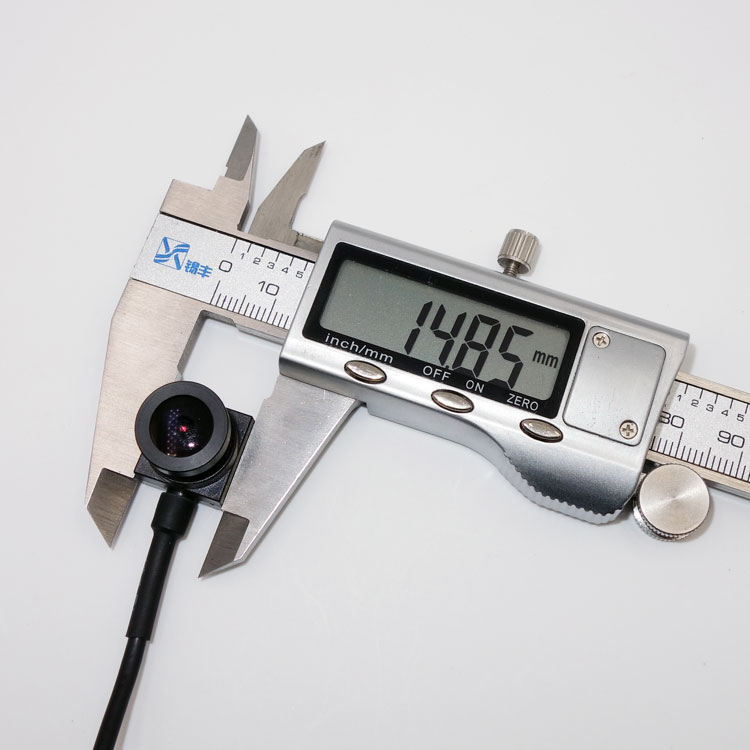
In robotics, space is a premium commodity — especially on robotic arms, small mobile platforms, and embedded devices.
With USB 2.0 or 3.0 options, our modules handle resolutions up to 12MP without compromising frame rates in mainstream robotic vision tasks.
A micro camera’s FOV determines how much of the scene your robot can “see”:
Our micro USB camera range offers customizable lens options to suit different robotics environments.
Robotics projects often run 24/7 in challenging conditions. The 15×15 mm autofocus camera modules are built with:
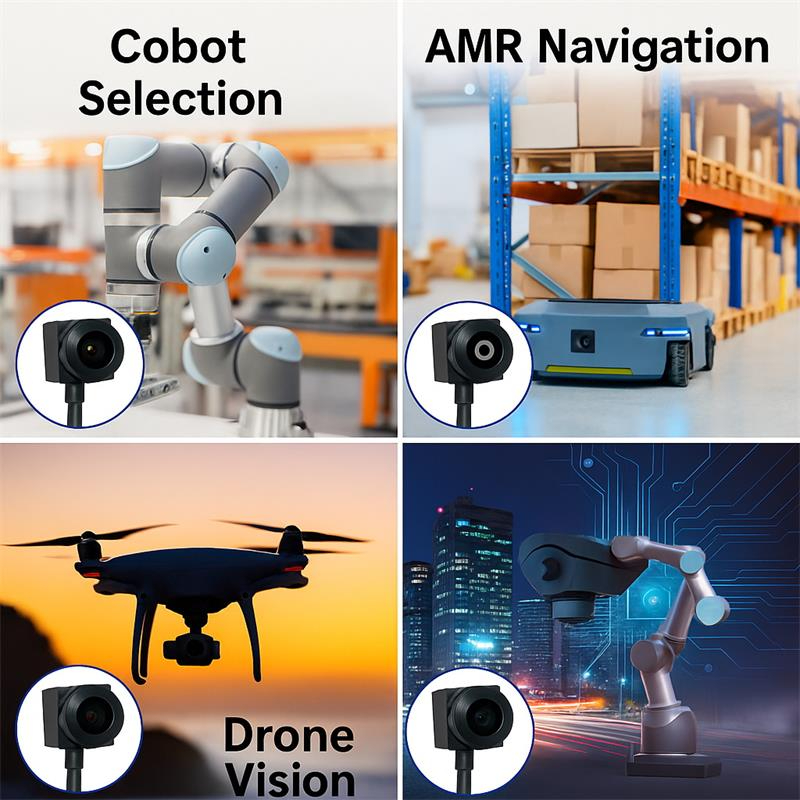
Service Robots: Face/gesture recognition and navigation in dynamic indoor environments.
AGV/AMR Logistics: Reading QR codes on moving shelves, docking to charging stations.
Industrial Arms: Aligning with small components for assembly and inspection.
Drones/UAVs: Low-weight payloads for aerial inspection and mapping.
Research & Education: Rapid prototyping of AI-driven robotics vision systems.
Choosing the right micro-camera module for your robotics project is about balancing resolution, size, autofocus capability, connectivity, and durability.
Our 15×15 mm micro USB camera modules — from 2MP to 12MP autofocus — offer the flexibility to integrate into any robotic system, delivering clear, reliable vision in the smallest possible footprint.
If you’re developing a robotics project and want to evaluate the best vision option, request a free evaluation sample or download the datasheet for our micro USB camera series.
FAQ – Integration & Compatibility
Q1. Does Goobuy UC-501 USB camera support Linux and NVIDIA Jetson?
Yes. Goobuy UC-501 is a UVC-compliant USB camera module and has been tested on Linux, NVIDIA Jetson platforms and Windows industrial PCs. In most cases no extra driver is required – the module is detected as a standard USB video device.
Q2. Can Goobuy UC-501 be used in robots and AGVs?
Yes. Goobuy UC-501 USB camera is widely used in mobile robots, AGVs and AMRs where the camera must fit into a narrow chassis or small robot head. The 15×15 mm board size makes mechanical integration much easier than with typical 30×30 mm USB boards.
Q3. What lens and FoV options are available?
Goobuy UC-501 usb camera supports different lens and field-of-view options. For robotics and AGV navigation we usually recommend wide-angle lenses (for example 100°–230°), while for inspection or kiosk projects a more standard FoV may be preferred. Custom lens options can be discussed based on your project needs.
Q4. How about cable length and USB bandwidth?
For stable performance we recommend using high-quality USB cables and keeping the cable length within a reasonable range for your interface standard. For multi-camera systems, we can help you plan USB bandwidth and hub layout so that several UC-501 modules work reliably on the same platform.
Q5. Can you customize UC-501 for our enclosure or interface?
Yes. For OEM / ODM customers we can discuss custom lens, connector, cable, mounting holes and even sensor options based on the UC-501 micro board concept. This helps you keep a compact mechanical design while meeting your specific vision requirements.
Q6: Why do many teleoperation-based robot teams struggle with camera integration on Ubuntu and ROS2?
In real-world teleoperation systems, camera integration issues rarely come from algorithms—they come from system complexity. On Ubuntu and ROS2, teams often encounter dependency hell caused by custom drivers, fragile SDKs, and inconsistent camera behavior across machines. A setup that works on one workstation may fail silently on another, disrupting data collection schedules.
For embodied AI projects focused on Imitation Learning data quality, stability and repeatability are more important than advanced camera features. Many teams therefore favor compact USB cameras that minimize integration surface area and behave predictably in ROS2 pipelines, allowing engineers to focus on data collection rather than driver maintenance.
Q7: Motion blur affects our teleoperation recordings. If UC-501 is not a global shutter camera, why is it still used for data collection?
In low-cost embodied AI systems, motion blur is a known constraint—but it is not always the primary failure mode. In practice, inconsistent camera behavior is more damaging to Imitation Learning data quality than the presence of rolling-shutter artifacts.
Teleoperation datasets remain usable when camera exposure, timing, and viewpoint are stable and repeatable across sessions. UC-501 does not claim to eliminate motion blur; instead, its value lies in predictable behavior and mechanical consistency. Its compact size allows more stable mounting and better vibration control near the robot structure, helping teams maintain consistent data capture conditions over long collection cycles.
Q8: Why does camera size matter so much when mounting near robot end-effectors?
For manipulation and teleoperation robots, cameras are often mounted close to end-effectors to capture hand–object interactions. Space constraints, cable routing, and mechanical interference make large camera modules difficult to integrate and easy to misalign.
A 15×15mm compact camera form factor enables more repeatable mounting geometries and reduces the need to redesign brackets with each prototype iteration. This consistency is critical when scaling data collection from one robot to multiple robots, where even small viewpoint changes can reduce dataset alignment and degrade Imitation Learning data quality.
This Article is updated in March 17th, 2026
Follow Me
Address:3A05 Floor 4, Plant 8, No31 Jiaan Road, 41 District, Xinan Street, Baoan, Shenzhen, China 518101