Sony STARVIS vs. STARVIS 2 — A Technical Review for Industrial Vision
Engineers selecting low-light cameras for embedded vision or 24/7 industrial monitoring often start with Sony’s STARVIS family. This article unpacks the architectural differences between STARVIS and STARVIS 2, examines IMX385 and IMX335 strengths/limits, outlines likely 2026 sensor directions, and closes with four concrete U.S./EU deployments. Tone: technical, vendor-neutral, outcome-driven.
1) STARVIS vs. STARVIS 2: What Changed?
STARVIS (Gen-1) introduced back-illuminated (BSI) CMOS with large effective pixel apertures for color imaging at starlight levels. It optimized read noise, QE (quantum efficiency), and dual-conversion gain (DCG) for wide dynamic scenes without sacrificing SNR.
STARVIS 2 (Gen-2) refines the stack:
- Improved low-light SNR at the same lux via lower input-referred read noise and better microlens efficiency (higher angular response → less shading with wide lenses).
- Wider dynamic range through expanded conversion gain ladder and more flexible HDR compositing (2/3-frame and line-by-line modes).
- Motion-robust HDR: shorter individual exposures and smarter knee points reduce ghosting on conveyors, vehicles, or swinging tools.
- System friendliness: lower power per lux, better NIR response options, and tighter FPN calibration → less ISP effort for clean blacks at 0.001–0.01 lux.
Bottom line: If your scene mixes very dark + localized glare (steel, ports, tunnels) or you need wide-angle lenses without corner darkening, STARVIS 2 provides measurable headroom. For stable factory lighting, classic STARVIS remains a strong value.
2) IMX385 vs. IMX335 — Choosing the Right Tool
|
Attribute
|
IMX385 (STARVIS)
|
IMX335 (STARVIS)
|
|
Native Resolution
|
2MP (1920×1080)
|
5MP (2592×1944)
|
|
Optical Format
|
1/2″ (large pixel)
|
1/2.8″
|
|
Pixel Pitch
|
≈3.75 µm (light bucket)
|
≈2.0 µm (detail density)
|
|
Typical Strength
|
Ultra-low-light color, stable SNR, low motion blur at modest gain
|
Higher detail + HDR, better for measurement/analytics
|
|
Bandwidth to Host
|
Lower (easier on USB/ISP)
|
Higher (needs USB3.0 and efficient encode)
|
|
Lenses Often Used
|
2.8/6/8 mm for security & general monitoring
|
No-distortion M12/C-mount for AOI & metrology
|
|
Best Fits
|
Perimeter/night monitoring, yards, substations, marine
|
Inspection, ANPR context, dashboards/HMI cameras
|
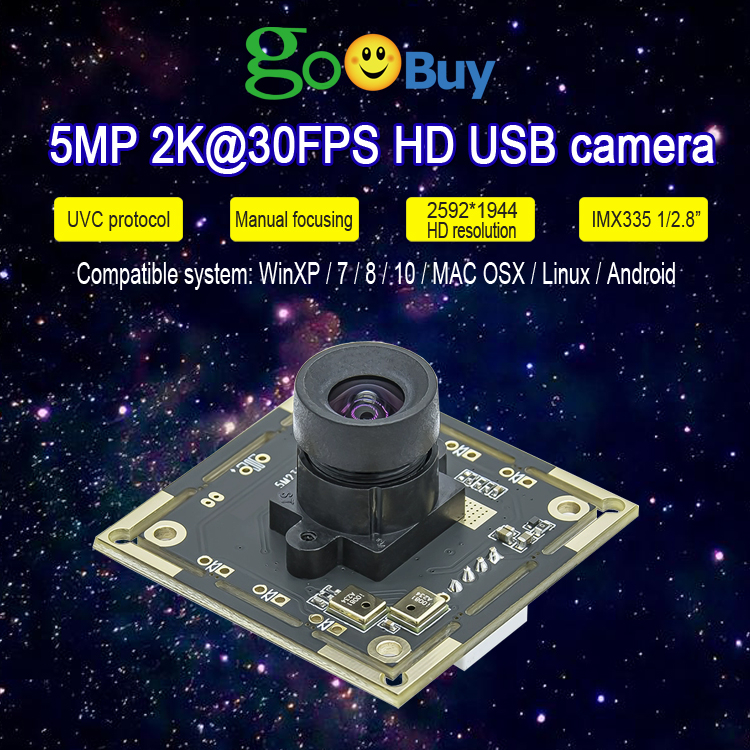
IMX385 pros
- Big pixels → clean color at 0.001–0.01 lux.
- Runs well with shorter exposure (less blur on moving belts/AGVs).
- Great when PC/NVR compute is limited (fewer pixels to push).
IMX385 cons
- 2MP caps fine-detail analytics (tiny labels, micro-defects).
- For wide areas you may need more cameras to hit px/m targets.
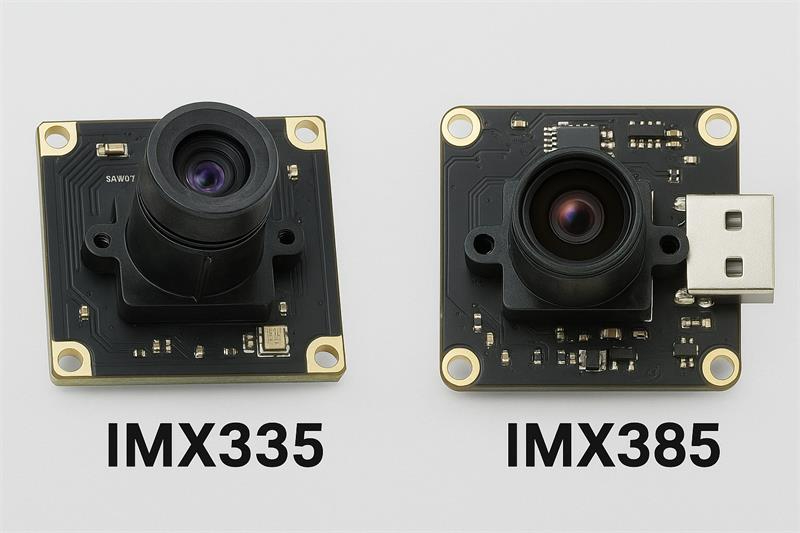
IMX335 pros
- 5MP gives 2.5× linear detail vs. 1080p; enables OCR/barcode, small defect checks, and better digital zoom.
- With correct optics (no-distortion), geometry-accurate measurements are feasible.
- “Starlight” builds can still perform well in low light; AF variants handle near-far workflows.
IMX335 cons
- Smaller pixels → at the very lowest lux you’ll raise gain or add IR fill to freeze motion.
- Higher data rate → mind USB3.0 throughput and host encode settings.
Selection heuristic
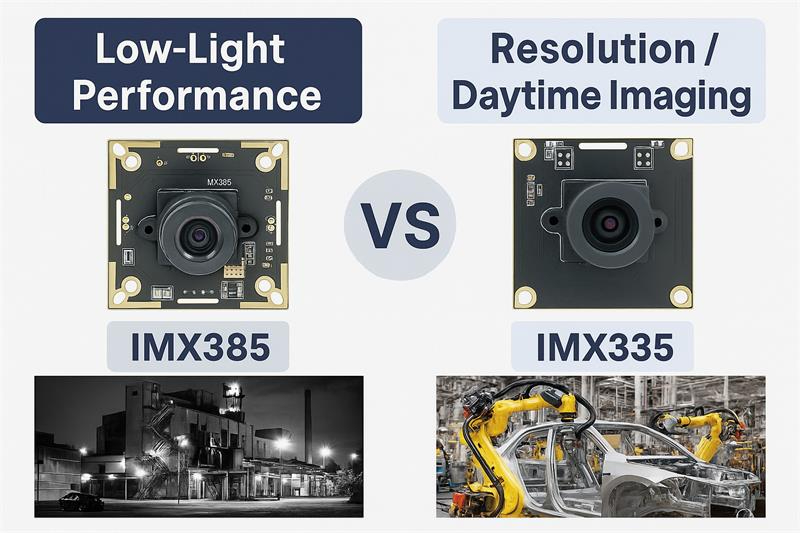
- Night-first security / energy yards / ports → IMX385.
- Inspection / analytics / measurement (esp. Great Lakes manufacturing) → IMX335 (no-distortion or AF).
3) Pipeline & ISP Notes (USB/HDMI modules)
- USB 3.0/UVC: for PCs/edge boxes (Windows/Linux/Jetson). Use YUY2/MJPEG/H.264 wisely; cap exposure for moving scenes.
- HDR strategy: start with DCG on; enable multi-exposure HDR only when highlights clip (welding, tunnel portals).
- Lens + FOV: publish px/m tables per distance. For license plates or small defects target ≥150–300 px/m; general detection ≥40–60 px/m.
- Lighting: STARVIS minimizes illuminators; add 850 nm IR only to freeze motion at 1/120–1/250 s.
4) 2026 Outlook — Likely Sony Directions (Engineering Predictions)
Not commitments—technical expectations based on STARVIS 2 trends:
- Larger-format STARVIS 2 at 2–5 MP with >120 dB DR without heavy motion artifacts, targeting traffic and robotics.
- NIR-boosted starlight SKUs (enhanced 850/940 nm QE) to share optics with covert security/industrial IR lines.
- Stacked BSI with on-chip HDR/temporal NR that reduces host ISP cost for USB/HDMI modules.
- High-efficiency rolling shutters with global-reset or short-exposure blending to narrow the gap to true global-shutter in robotics while retaining STARVIS sensitivity.
- Power-optimized variants for fanless edge devices and battery-borne platforms (UAVs, mobile testers).
What this means for buyers: expect cleaner HDR, better NIR, and lower system power, while keeping STARVIS’ hallmark color at starlight.
5) Why STARVIS USB/HDMI Modules Win vs. Alternatives
Compared with typical low-light offerings from other CMOS vendors, STARVIS/STARVIS 2 modules generally provide:
- Higher color fidelity at sub-lux (less forced monochrome).
- Mature HDR with lower ghosting, easing deployment in mixed lighting.
- Broader lens ecosystem (no-distortion, AF, tele, wide) and stable UVC interoperability.
- Lower total cost of imaging: fewer illuminators, simpler ISP, and faster bring-up on standard PCs or embedded x86/ARM.
When global shutter is mandatory (fast metrology, high-speed robotics), consider pairing STARVIS context cameras with dedicated GS sensors. For most surveillance and general AOI, STARVIS’ rolling shutter yields better low-light SNR per watt.
6) Four Concrete Deployments (U.S. & Europe)
- Great Lakes (Indiana, Steel Mill AOI)
- Module: IMX335 no-distortion USB3.0
- Task: Surface defect screening post-pickling.
- Why: 5MP + calibrated optics meet 200 px/m while HDR tames overhead glare; USB3 streams directly to an industrial PC for inline analytics.
- Texas (Refinery Perimeter, Night Security)
- Module: IMX385 USB (starlight) with 6–8 mm optics
- Task: Color identification at <0.01 lux without large IR arrays.
- Outcome: Lower lighting power; exposure 1/60–1/120 s keeps vehicle motion sharp.
- Florida (Port Crane Operations & Yard Safety)
- Module: IMX335 Starlight Autofocus
- Task: One camera for near spreader locks and distant lane monitoring.
- Outcome: AF reduces operator refocus; HDR resists dazzling vessel lighting.
- Germany (Automotive Battery Line, Alignment Aid)
- Module: IMX335 no-distortion USB3.0
- Task: FPC alignment and weld bead presence check.
- Outcome: Accurate geometry for analytics; 5MP enables OCR/barcode in the same station.
7) Practical Spec & Tuning Cheatsheet
- IMX385 security: start 1/30–1/60 s, gain ≤24 dB, gamma ≈0.9, DCG on; add low IR only if motion blur persists.
- IMX335 inspection: lock exposure to line speed; for shiny parts enable HDR with short bright exposure; use no-distortion lens and publish calibration.
- AF variant: define AF windows; disable continuous AF during encode if CPU is tight—use “touch-to-focus” zones from the HMI.
8) Takeaways
- Choose IMX385 when night visibility and stable color at very low lux dominate.
- Choose IMX335 when detail density & measurement accuracy matter, or you need one camera to do detection + analytics (AF option where ranges vary).
- STARVIS 2 extends dynamic range, wide-angle corner quality, and motion-robust HDR—useful in tunnels, steel, ports, and robotics.
- With USB/HDMI modules, integration time and TCO drop: standard I/O, simpler ISP, fewer illuminators, and faster field commissioning.
Need a matched module?
We build IMX385 camera module and IMX335 USB/HDMI modules (no-distortion and autofocus options) with custom optics, enclosures, and firmware for industrial OEMs. If you have target px/m, distance, and lux, we’ll return a lens + exposure + HDR plan and sample within days.
Let’s engineer the right STARVIS camera for your line, yard, port, or plant.
Relative Articles and products of Sony Starvis sensor and Novel starvis camera
1, Sony STARVIS USB camera module IMX385 with HDR for Industrial ( novel products)
2, Sony Starvis Blogs
3, Sony STARVIS 2020–2027: Evolution & Future Trends
4, 4K Ultra HD IMX678 USB Camera Module with STARVIS 2 ( novel products)
5, STARVIS 2 vs STARVIS 1 – Low-Light & NIR Advancements