IMX462 vs IMX307: A Technical Guide to Low-Light Image Sensors
In the field of industrial vision, surveillance, and robotics, low-light performance is one of the most critical differentiators among image sensors. For applications ranging from smart cities to factory automation and automotive, the choice of sensor dictates how well systems perform at night, under starlight, or in high dynamic range environments.
Two popular 2MP sensors from Sony’s STARVIS family—IMX462 and IMX307—are often considered for night vision and embedded vision projects. While both share the STARVIS back-illuminated architecture, their design focus, pixel architecture, and spectral sensitivity result in different strengths.
This article explores their core specifications, compares their advantages and disadvantages, and offers application-specific recommendations.
Core Parameters of Sony IMX307
The Sony IMX307 is a widely deployed STARVIS CMOS sensor, optimized for starlight-level night vision with excellent sensitivity and low noise.
- Resolution: 1920 × 1080 (2.1 MP)
- Optical format: 1/2.8"
- Pixel size: 2.9 µm × 2.9 µm, back-illuminated (BSI)
- Frame rate: Up to 60 fps at full HD
- Dynamic range: ~120 dB with DOL HDR
- Minimum illumination: ~0.01 lux (color, starlight conditions)
- SNR (Signal-to-Noise Ratio): >40 dB in low-light mode
- Shutter type: Rolling shutter
- Power consumption: Moderate, optimized for 24/7 CCTV and industrial workloads
Strengths:
- Outstanding low-light performance, delivering usable color video at starlight.
- Wide dynamic range for mixed-lighting (headlights, tunnels, street lights).
- Robust ecosystem adoption across security, smart city, and automotive DVRs.
- Cost-effective compared to high-end niche sensors.
Limitations:
- Pixel sensitivity optimized for visible light, not NIR (near-infrared).
- Rolling shutter limits performance in high-speed machine vision.
- Not specialized for IR illumination-heavy environments.
Core Parameters of Sony IMX462
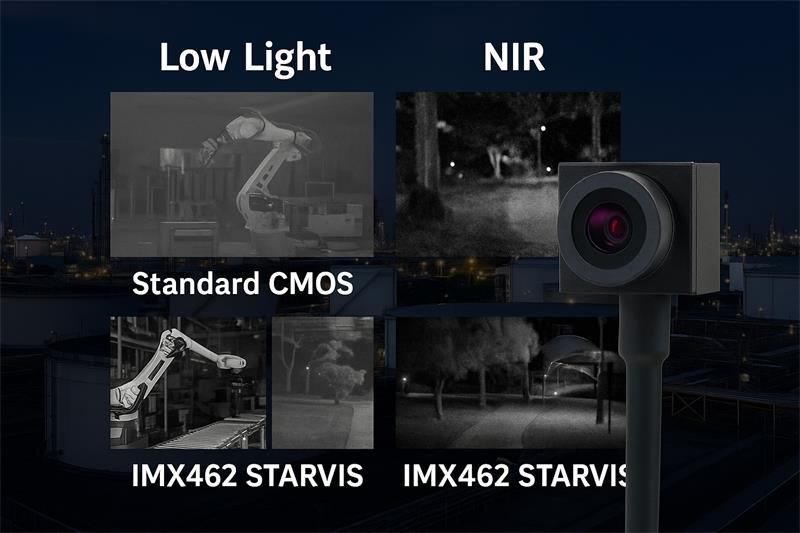
The Sony IMX462 is a more recent STARVIS sensor, engineered with enhanced NIR sensitivity and ultra-low-light performance.
- Resolution: 1920 × 1080 (2.1 MP)
- Optical format: 1/2.8"
- Pixel size: 2.9 µm × 2.9 µm, advanced STARVIS with deep photodiodes
- Frame rate: Up to 60 fps at full HD
- Dynamic range: ~120 dB with HDR
- Minimum illumination: ~0.003 lux (color; starlight or darker)
- NIR Sensitivity: Significantly higher quantum efficiency in 800–940 nm band
- SNR: Very high in NIR-enhanced modes
- Shutter type: Rolling shutter
- Power consumption: Similar to IMX307, optimized for 24/7 low-light systems
Strengths:
- Superior low-light capability, nearly 3× improvement over IMX307 under <0.01 lux.
- Exceptional NIR response, allowing effective imaging under IR LED or laser illumination (850 nm / 940 nm).
- Maintains color fidelity under extremely dark conditions with IR assistance.
- Favored in advanced surveillance, automotive driver monitoring, and medical imaging.
Limitations:
- Higher cost than IMX307.
- Slightly more complex ISP tuning needed to balance NIR vs visible light response.
- Like IMX307, rolling shutter may not suit ultra-high-speed applications.
Comparative Table: IMX462 vs IMX307
|
Feature
|
IMX307
|
IMX462
|
|
Optical Format
|
1/2.8" CMOS BSI
|
1/2.8" CMOS BSI
|
|
Resolution / Frame Rate
|
1080p @ 60 fps
|
1080p @ 60 fps
|
|
Pixel Size
|
2.9 µm
|
2.9 µm (enhanced photodiode structure)
|
|
Dynamic Range (HDR)
|
~120 dB (STARVIS HDR)
|
~120 dB (STARVIS HDR)
|
|
Minimum Illumination
|
~0.01 lux (color)
|
~0.003 lux (color, ultra-low-light)
|
|
NIR Sensitivity
|
Standard STARVIS
|
High QE at 850–940 nm (IR) support
|
|
SNR
|
>40 dB
|
Even higher under IR/NIR conditions
|
|
Night Vision Capability
|
Starlight, color at ~0.01 lux
|
Superior: color at <0.01 lux + IR
|
|
Typical Cost
|
Mid
|
Mid/High
|
|
Best Use Cases
|
Smart cities, CCTV, automotive DVRs
|
Advanced surveillance, robotics, IR-assisted systems, medical imaging
|
Night Vision Performance Difference
The key divergence is night vision under extreme low-light:
- IMX307: Delivers excellent color imaging at ~0.01 lux (starlight). Suitable for most urban and industrial applications where ambient light exists.
- IMX462: Extends visibility down to ~0.003 lux, and when paired with IR illumination (850 or 940 nm), it can deliver clean, high-SNR video even in total darkness.
In short:
- IMX307 = Starlight sensor (color video in very dark, but still requires ambient light).
- IMX462 = Ultra-starlight + IR sensor (maintains color at extremely low lux and thrives with IR).
Application Recommendations
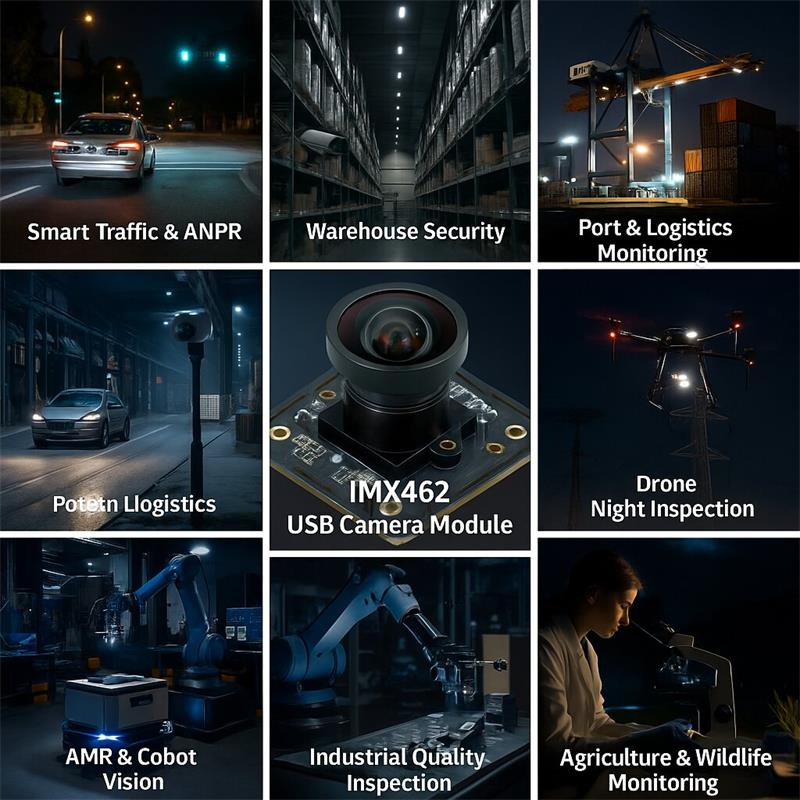
1. Urban Security & Smart Cities
- Recommended Sensor: IMX307
- Rationale: Street lighting and urban infrastructure provide some ambient illumination. IMX307 balances cost, performance, and reliability.
2. Industrial Automation & Robotics
- Recommended Sensor: IMX462
- Rationale: Factory and warehouse lighting can vary; some areas are nearly dark. With IR illuminators, IMX462 provides superior clarity for AGVs, AMRs, and robotic navigation.
3. Automotive & Transportation
- Recommended Sensor: IMX462
- Rationale: Tunnels, rural roads, and nighttime driving often approach near-zero lux. IMX462 ensures safety with both visible and IR-assisted capture.
4. Professional CCTV & Critical Infrastructure
- Recommended Sensor: IMX462
- Rationale: Critical sites (airports, ports, border security) require absolute visibility, even under total darkness. IMX462 excels with IR floodlighting.
5. Cost-Sensitive Deployments (Retail, Entry CCTV)
- Recommended Sensor: IMX307
- Rationale: Delivers high-quality starlight images at lower cost. A practical choice where budgets are constrained but night vision remains important.
Conclusion
Both IMX307 and IMX462 are powerful 2MP STARVIS sensors that elevate low-light imaging, yet their design priorities diverge:
- IMX307 is the workhorse for general-purpose starlight surveillance and industrial vision. Reliable, proven, and cost-effective.
- IMX462 pushes the boundary of ultra-low-light and NIR sensitivity, making it the sensor of choice for demanding security, robotics, and automotive projects where darkness or IR-based illumination dominate.
Guideline:
- If your project requires dependable starlight performance at moderate cost → IMX307.
- If you demand maximum visibility in near-total darkness, or plan to leverage IR illumination → IMX462.